
Table of Contents
- Why Soil Compaction Matters for Synthetic Turf Installation
- Assessing Your Soil Type, Moisture, and Existing Compaction
- Soil Preparation for Artificial Grass: Removing and Grading
- Base Materials for Synthetic Turf and Compaction Techniques
- Drainage Under Artificial Turf: Preventing Pooling and Movement
- Synthetic Turf Sub-Base Depth and Stability Standards
- Troubleshooting Settling, Footprints, and Surface Movement
- Frequently Asked Questions
Last Updated: October 12, 2026
Why Soil Compaction Matters for Synthetic Turf Installation
Preventing soil compaction under synthetic turf is one of the most overlooked installation steps.
When soil compacts too much, it loses its ability to drain water, support weight, and remain stable.
Preventing soil compaction is manageable once you understand the difference between useful compaction (your base layer) and harmful compaction (your native soil).
This guide covers evaluating your soil, preparing the site, selecting base materials, and compacting them without damaging the earth beneath.
Assessing Your Soil Type, Moisture, and Existing Compaction
Before you break ground, know what you’re working with. Soil type, moisture level, and existing compaction all affect installation performance.
Soil type determines drainage and stability. Clay holds water and compacts easily.
To identify your soil type, dig a small hole about 6 inches deep. Grab a handful of moist soil and squeeze it:
- Stays in a tight ball: clay
- Crumbles apart immediately: sand
- Holds shape but breaks apart easily: loam
Moisture matters because wet soil compacts differently than dry soil. Too wet becomes unstable and compacts unevenly; too dry resists compaction.
Existing compaction tells you how much work lies ahead. Heavily used lawns may already be compacted.
Soil Preparation for Artificial Grass: Removing and Grading
Once you understand your soil, prepare the site: remove grass and debris, then grade for a stable, level surface.
Remove all existing grass, weeds, and organic debris. Dead grass and roots decompose over time, leaving voids beneath your base layer.
After removal, clear the exposed soil of rocks, roots, and sticks, leftover debris creates soft spots or uneven surfaces.
Grade the area to slope slightly for drainage. A 1 percent slope (roughly 1 inch of drop per 8 feet) lets water flow away from low spots and prevents pooling.
Base Materials for Synthetic Turf and Compaction Techniques
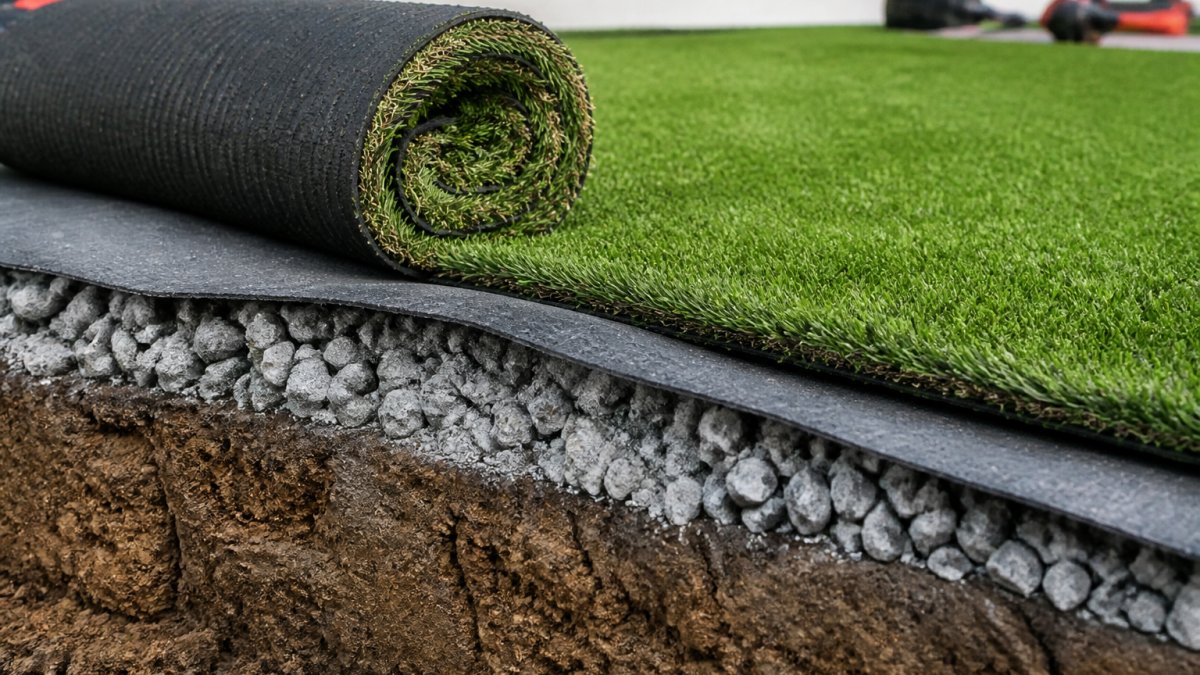
Your base layer is where most compaction happens, and where it should. The right materials and technique prevent the native soil from compacting further while creating a stable, draining foundation.
Crushed Stone and Decomposed Granite Options
Crushed stone is the most common choice. Angular stones lock together when compacted, creating a stable, draining layer; 4-6 inches is typical for residential installations.
Decomposed granite (DG) is popular in the South. It compacts tighter than crushed stone for high-traffic stability but is denser and drains slower.
Crushed granite is a middle ground. Denser than crushed stone but more draining than DG, it suits most residential applications.
The key difference: angular materials compact and interlock. Rounded gravel shifts and settles over time.
Compaction Equipment and Lift Thickness
Lift thickness is critical. Compact your base in layers, not all at once:
- Spread 2-3 inches of base material
- Compact thoroughly with a plate compactor or vibratory roller
- Add another 2-3 inch layer and compact again
Thin lifts compact evenly; thick lifts leave soft spots that settle later.
Equipment choices depend on area size. For areas under 500 square feet, a hand-operated plate compactor works well; for larger areas, rent a vibratory roller.
Make multiple passes. After spreading each lift, make at least 3-4 passes, overlapping each by half, to ensure uniform density and prevent soft spots.
Drainage Under Artificial Turf: Preventing Pooling and Movement
Water management is essential for preventing soil compaction problems: pooling water creates soft spots, and water that can’t drain destabilizes the entire system. Drainage failures rarely show up at installation, they appear weeks or months later, buried under turf and base.
How Water Actually Moves Through a Turf System
Water hits the turf surface, passes through the backing and perforations, enters the infill, then reaches the base layer. From there it either percolates into the native soil or flows laterally along the slope to a drainage point. A failure at any stage backs water up to the surface.
The three most common failure points are:
- Compacted native soil beneath the base. Water reaches the soil, cannot infiltrate, and sits in the base like a bathtub.
- A base layer that is too fine or too tightly compacted. Crushed stone with a high fines content, or decomposed granite compacted too aggressively, can become nearly impermeable.
- Insufficient or incorrect slope. Water has nowhere to go and pools in the lowest spot.
Matching Drainage Strategy to Soil Type
The right drainage approach depends on what is under your base:
- Sandy soil. Drains quickly on its own. A geotextile fabric over the native soil keeps fines from migrating up into the base. Slope can be minimal.
- Loam. Moderate infiltration. Standard 1 percent slope plus a geotextile separation layer usually works.
- Clay. Slow to effectively zero infiltration. Clay needs a perforated drain pipe in a gravel-filled trench along the low edge, or a drainage cell mat under the base. Increase slope to 1.5-2 percent.
Slope, Fabric, and Subsurface Drains
Slope. A 1 percent slope (roughly 1 inch of drop per 8 feet) is the minimum for most residential installations; in wet climates or on clay, increase to 1.5-2 percent.
Geotextile fabric. A non-woven geotextile on the native soil separates the base from the soil so fines don’t migrate upward and clog it, while allowing water to pass through.
Subsurface drains. In areas prone to water accumulation, a perforated pipe wrapped in filter fabric and set in a gravel trench along the low edge gives water a path out.
If your yard has a natural low spot, do not fight it. Grade the turf area to drain toward that spot, then make sure the spot itself has somewhere to send water. A low spot that fills and stays full is a low spot that will eventually undermine your base.
Symptom-to-Cause Troubleshooting
When something goes wrong after installation, the symptom usually points to the cause:
- Puddling after rain that drains within a few hours. Normal for heavy storms.
- Puddling lasting more than 24 hours. Base is too tight, slope insufficient, or native soil isn’t accepting water. Check slope first, then probe the base for hardness.
- Soft, spongy areas underfoot even when dry. Water is trapped beneath the turf, likely a compacted native soil layer or clogged geotextile. May require pulling back turf and adding a subsurface drain.
Maintenance That Protects Drainage
Drainage is not a one-time decision. Over years, infill migrates, debris accumulates, and the base can shift. A few habits keep the system working:
- Brush or blow leaves and debris off the turf rather than letting them break down into the infill.
- Rinse the surface occasionally to move fine dust through the system.
- After heavy storms, walk the area and note new low spots or soft patches.
Drainage failures are almost always a preparation problem, not a turf problem. Match your drainage strategy to your soil type, verify slope after compaction, and treat any persistent puddle as a signal to investigate the base, not just the surface.
Synthetic Turf Sub-Base Depth and Stability Standards
Sub-base depth directly affects how well preventing soil compaction works and how stable your turf remains. But depth alone tells you little, what matters is how the material behaves at that depth, and how you confirm it.
Standard depth is 4-6 inches for residential installations, enough material to compact properly while allowing adequate drainage. For high-traffic areas, dog runs, play zones, and sports fields, consider 6-8 inches.
What a Compaction Percentage Actually Means
You’ll see numbers like “95 percent compaction” in spec sheets and contractor bids. That figure comes from a lab test, typically a Proctor test, establishing the maximum dry density a material can reach under a controlled hammer blow.
For residential synthetic turf, most practitioners aim for a firm, uniform base rather than a specific percentage. The practical target: a surface that doesn’t deflect under a heel, doesn’t rut under a wheelbarrow, and drains freely.
Do not confuse base compaction with native soil compaction. You want the aggregate base dense and interlocked. You want the native soil beneath it firm but still permeable. Over-compacting native soil is one of the most common causes of post-installation drainage failure.
How to Verify Compaction on a Residential Project
You don’t need a nuclear density gauge to check your work. A few simple methods tell you whether the base is uniform:
- The heel test. Walk the area in hard-soled shoes. A properly compacted base feels solid and consistent; soft spots telegraph as a slight give.
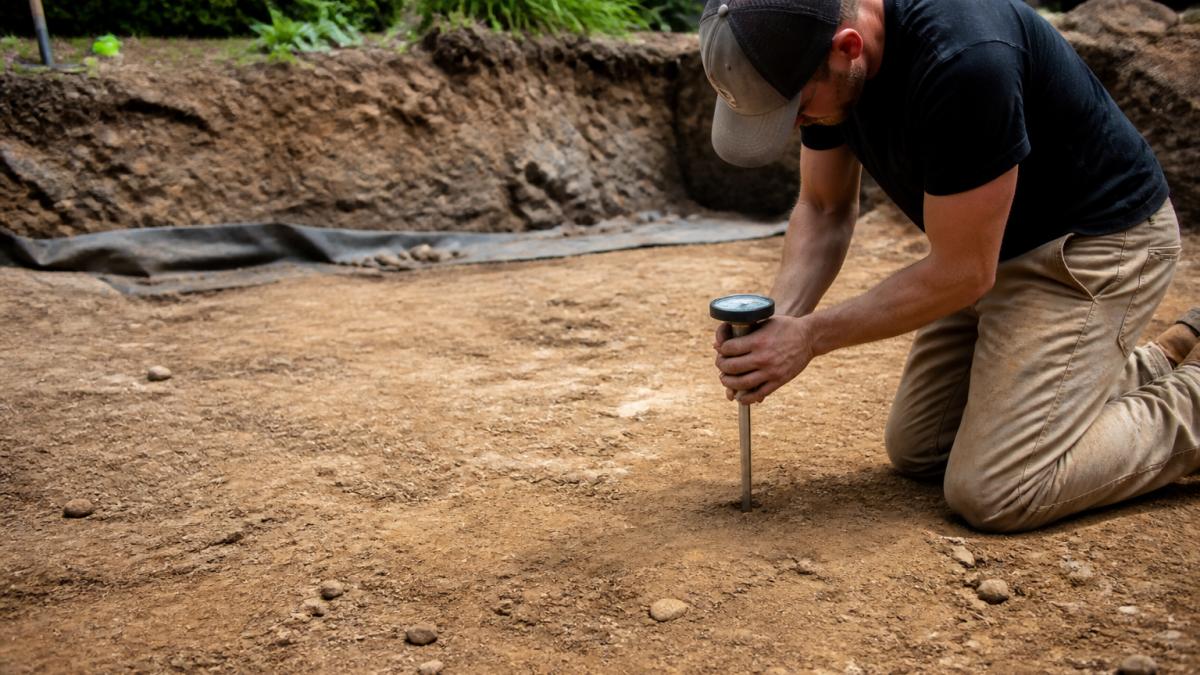
- The screwdriver probe. Push a long screwdriver into the base at several points. Resistance should feel roughly the same everywhere. If it sinks easily in one area and stops hard in another, compaction is uneven.
- The plate compactor pass count. Track passes per lift. If one section got three and another six, you have a uniformity problem even if both feel firm.
Matching Depth to Load
Depth should scale with use:
- Light residential foot traffic: 4 inches of compacted base is usually sufficient.
- Family lawns with occasional pets: 4-5 inches, with attention to drainage under pet areas.
- Dog runs and heavy pet use: 6 inches, plus a drainage layer and matting-resistant infill.
- Play structures and sports zones: 6-8 inches, compacted in thinner lifts for uniformity.
The deeper the base, the more important lift thickness becomes. A 6-inch base in two 3-inch lifts almost always outperforms the same 6 inches in one pass, because a compactor only densifies the top few inches of any lift.
When Testing Is Worth the Cost
For a typical residential lawn, visual and tactile checks are enough. Testing is worthwhile when:
- The installation is commercial, a sports field, or an HOA common area with higher liability and performance expectations.
- The native soil is heavy clay or has a history of drainage problems.
- A contractor offers a warranty that depends on base performance.
- You’re repairing a failed installation and need to know whether the base or drainage was the root cause.
A third-party lab can run density and moisture tests and give you a written report. The cost is modest relative to tearing out and reinstalling turf.
Depth sets the ceiling on performance. Compaction uniformity determines whether you actually reach it. Verify both, and do not rely on a single percentage to tell you the job is done.
Troubleshooting Settling, Footprints, and Surface Movement
Even with proper preparation, issues can arise. Here’s how to diagnose and fix them.
Footprints or indentations appearing after installation usually mean the base wasn’t compacted uniformly or the native soil beneath is too soft.
Settling in low spots or uneven surfaces indicates insufficient base depth, poor grading, or water pooling beneath the surface.
Soft or spongy areas under foot suggest water is trapped beneath the turf or the base is too loose.
Proper preparation transforms a synthetic turf installation from a short-term fix into a decades-long investment. Southern Artificial Turf’s installations are engineered to perform, but they depend on a solid foundation. Get a quote from Southern Artificial Turf and let us guide you through a preparation plan tailored to your soil and climate.
Frequently Asked Questions
Should soil be compacted before installing artificial turf?
Yes, but with care. The native soil beneath your synthetic turf needs compaction to create a stable foundation, but over-compaction causes settling and prevents proper drainage. Aim for approximately 80 percent compaction of the native soil layer, then add your aggregate base on top. This two-layer approach prevents soil compaction problems while maintaining stability for high-traffic areas.
What is the best base material for artificial turf?
Crushed stone, crushed granite, and decomposed granite are the most common choices for synthetic turf sub-bases. Crushed stone (3/4 inch) drains quickly and compacts well for high-traffic areas. Decomposed granite offers better stability on slopes. Layer your base material in 2-3 inch lifts and compact each layer separately to achieve proper density without crushing the aggregate itself.
How deep should the base be under artificial turf?
Most residential installations require 4-6 inches of compacted aggregate base, while high-traffic commercial or sports areas may need 6-8 inches. The depth depends on your soil type, drainage conditions, and expected foot traffic. Proper synthetic turf sub-base depth prevents settling and surface movement over time, especially in wet climates or areas with clay soil.
Can I lay artificial turf directly on soil?
No. Laying synthetic turf directly on native soil causes pooling, uneven settling, and rapid deterioration. Proper soil preparation for artificial grass requires removing existing grass and debris, grading the area, and installing a compacted aggregate base layer. This foundation prevents the soil movement and footprints that occur without a proper sub-base.