
Last Updated: November 3, 2026
Quick Summary
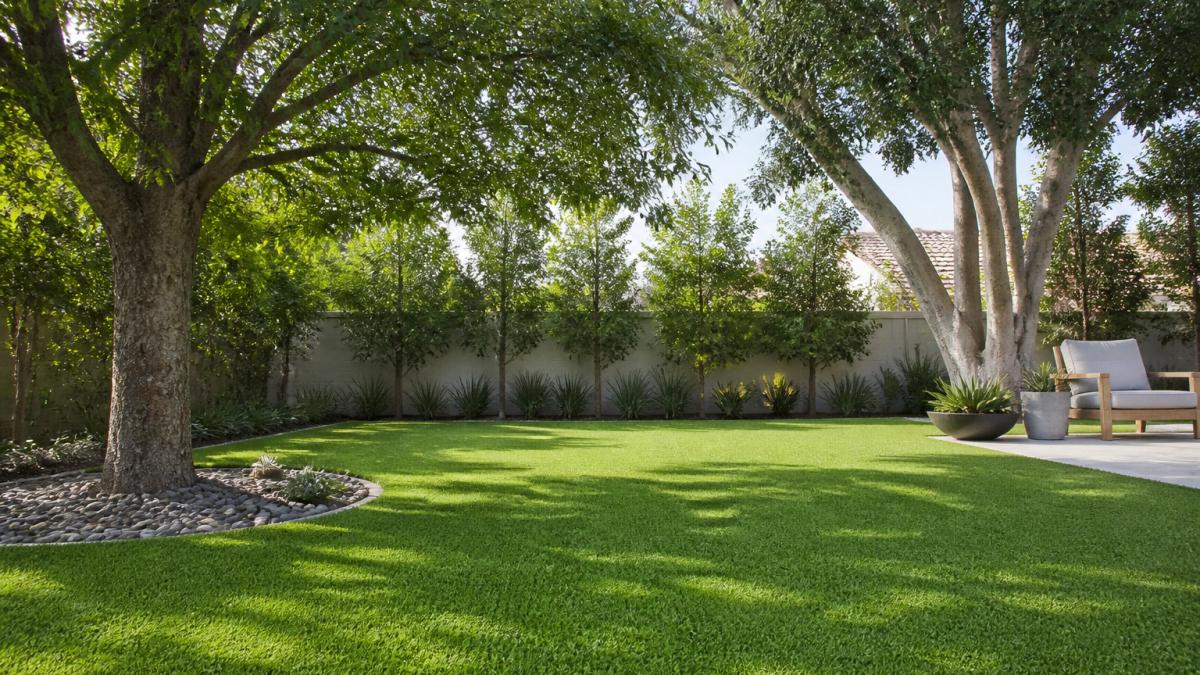
The best shade trees to plant near artificial grass have shallow but non-aggressive roots, a canopy that sits well above the turf, and little seed, sap or fruit drop. These traits matter more than shade density. Good examples include crape myrtle, Japanese maple, eastern redbud, ginkgo and thornless honey locust, depending on your climate zone.
- Choose trees with shallow but non-aggressive roots that will not lift the turf base.
- Raise the canopy above the turf so low branches do not drop debris onto the surface.
- Crape myrtle, Japanese maple and eastern redbud have light litter loads near turf.
- Keep turf and foot traffic outside the drip line and never run the base up to the trunk.
- Plant for the mature spread of the tree, not the size it has in the nursery pot.
Table of Contents
- Why Tree Choice Matters More Around Artificial Grass
- Artificial Grass Around Trees: What Changes Under Shade
- How to Choose Shade Trees With Non-Invasive Roots
- Low-Mess Shade Trees for Landscaping Near Turf
- Installing Artificial Turf Under an Oak Tree
- Keeping Leaves, Debris and Heat Under Control
- Frequently Asked Questions
Choosing a shade tree for a yard with artificial grass differs from choosing one for a natural lawn. Real grass needs sun, and thirsty tree roots compete with it for water.
Here is the short answer: pick a tree with shallow but non-aggressive roots, a canopy that sits well above the turf, and little seed, sap or fruit drop. Those traits matter more than the tree’s shade density.
Why Tree Choice Matters More Around Artificial Grass
A tree that drops sticky sap, heavy fruit or seed pods onto turf creates a weekly cleaning job. A tree with roots that heave the subbase can lift seams and create low spots where water pools.
Choosing a low-mess, non-invasive species at the start avoids most of these issues and costs far less than removing a tree planted too close to the turf.
Artificial Grass Around Trees: What Changes Under Shade
Shaded turf stays damp longer, which can encourage algae, moss and organic debris to collect on the surface. Find out whether sand infill makes artificial grass hotter.
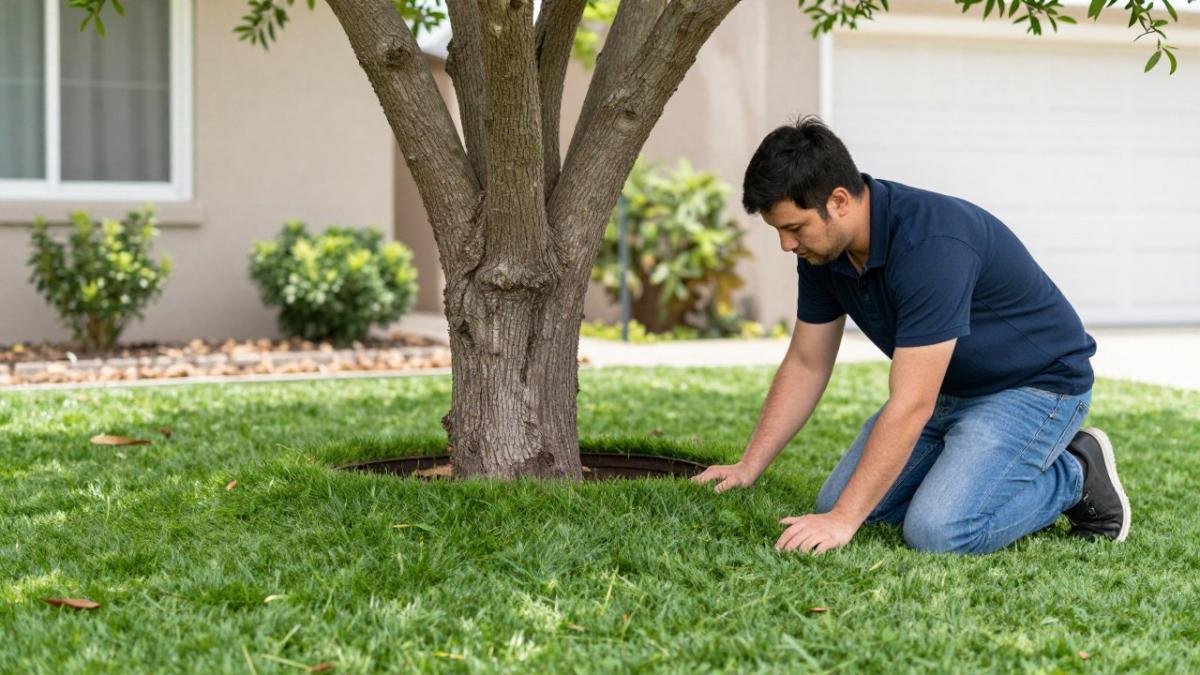
Account for the tree’s root zone before setting the base. Compacted soil under turf holds water and slows drainage, so prepare the subbase carefully where roots are present. Learn how to prevent soil compaction under synthetic turf.
How to Choose Shade Trees With Non-Invasive Roots
Start with the tree’s mature size, not its size at planting. A tree that looks modest in a nursery can spread far beyond the turf edge in twenty years. Check the mature height, canopy width and root habit before you buy.
Root System Traits to Look For
Look for trees with deep, structural roots and few aggressive surface roots. Shallow, spreading roots are the ones most likely to lift turf and damage edging. Avoid trees known for surface root mats, such as some maples and willows, if they will sit close to the turf.
Good signs include:
- A taproot or deep lateral system
- Moderate growth rate, which tends to mean a sturdier root structure
- Little history of sidewalk or foundation lifting in your area
Ask a local nursery which species have caused problems in your neighborhood; local experience often beats general guides.
Drip Line and Canopy Spacing
The drip line is the outer edge of the tree canopy, where rainwater falls. Keep turf installation and heavy foot traffic outside the drip line where possible, never run a subbase right up to the trunk, and leave a buffer of several feet between the trunk and the first seam.
Plan the tree so its mature canopy clears the turf area. Low branches that hang over the lawn drop debris every season, so raising the canopy by pruning helps keep the surface clean.
Low-Mess Shade Trees for Landscaping Near Turf
The right species depends as much on where you garden as on how much shade you want. The table below pairs commonly planted shade trees with the USDA hardiness zones where they perform, their mature size, and how they behave next to synthetic turf. Confirm local suitability with a nursery before planting, since soil, irrigation and municipal tree lists vary by location.
| Tree | USDA Zones | Mature Height / Spread | Root Habit Near Turf | Litter Load | Turf Pairing Notes |
|---|---|---|---|---|---|
| Live oak (Quercus virginiana) | 8-11 | 40-80 ft / 60-100 ft | Wide, shallow, aggressive | Heavy (leaves, acorns year-round) | Best kept outside the turf footprint or behind a root barrier |
| Northern red oak (Quercus rubra) | 3-8 | 60-75 ft / 45-50 ft | Deep taproot, moderate surface roots | Moderate to heavy in fall | Better root profile than live oak; still plan for leaf cleanup |
| Crape myrtle (Lagerstroemia spp.) | 6-10 | 15-30 ft / 10-20 ft | Shallow but non-heaving | Light (blooms, small leaves) | Good for small yards and patio edges; limited shade |
| Southern magnolia (Magnolia grandiflora) | 7-10 | 60-80 ft / 30-50 ft | Shallow, fleshy, non-aggressive | Heavy (large leaves year-round) | Attractive but steady cleanup; keep turf back from the trunk ring |
| Japanese maple (Acer palmatum) | 5-9 | 15-25 ft / 10-20 ft | Compact, shallow, gentle | Light | Ideal for small shaded spaces; not a heavy-shade tree |
| Eastern redbud (Cercis canadensis) | 4-9 | 20-30 ft / 25-35 ft | Moderate, non-aggressive | Light to moderate (seed pods) | Works near play areas; understory shade only |
| Ginkgo (Ginkgo biloba, male cultivars) | 3-9 | 50-80 ft / 30-40 ft | Deep, sturdy | Moderate in fall, no fruit on males | Strong choice where fruit drop is a concern; specify male clones |
| Honey locust (Gleditsia triacanthos, thornless) | 3-9 | 30-70 ft / 30-50 ft | Deep, spreading, moderate | Light (small leaflets) | Fine-textured shade that filters rather than blocks light |
| Zelkova (Zelkova serrata) | 5-8 | 50-80 ft / 50-60 ft | Deep, strong | Moderate in fall | Good street-tree profile; give it room from the turf edge |
How to Read the Table
Three columns matter most for turf. Root habit tells you whether a barrier is mandatory or optional. Litter load tells you how often you will be blowing the surface. Mature spread tells you how far the drip line will eventually reach, plant for the tree you will have in twenty years, not the one in the nursery pot.
The heaviest-shade trees (oaks, magnolias) also carry the heaviest litter and the most aggressive roots, while the lightest-litter trees (crape myrtle, redbud, Japanese maple) give filtered or understory shade rather than dense canopy. No species gives deep shade, zero litter and a timid root system; the table helps you choose which trade-off fits your yard.
Regional Pairings Worth Knowing
- Zones 8-10, hot and humid: Live oak for structure, crape myrtle for scale, southern magnolia for evergreen screening. Plan for year-round leaf drop from the evergreens.
- Zones 6-8, mixed: Northern red oak, zelkova and thornless honey locust give strong shade with manageable litter. Ginkgo is a good substitute where fruit drop is a dealbreaker.
- Zones 4-6, cold: Red oak, ginkgo and thornless honey locust are the workhorses. Japanese maple and redbud work as understory accents near patios and turf edges.
Species to Approach With Caution Near Turf
Some popular shade trees are poor neighbors for a synthetic lawn because of surface roots, heavy fruit, or both. Silver maple, willow, poplar and sweetgum are the usual offenders, sweetgum in particular drops spiky seed balls that are painful underfoot and hard to clear from turf fibers. Bradford pear and other callery pear cultivars are invasive in much of the country.
USDA PLANTS Database hardiness and native range lookup
A Note on Heat and Canopy
Canopy density is not just a shade question. A dense canopy over turf lowers surface temperature in the shaded zone, the single biggest comfort gain from planting near synthetic grass. A light-canopy species like honey locust filters heat without blocking it, so the turf under it stays warmer than turf under an oak. Match canopy density to how much cooling you want, and remember the sunny edge of any canopy line will always run hotter than the shaded interior.
Installing Artificial Turf Under an Oak Tree
Oaks are common in established yards and can be challenging to pair with synthetic turf. Their roots run wide and shallow, and their leaf and acorn drop is heavy. Installation under an oak is a sequencing problem more than a materials problem: decide the root zone first, then design the turf around it.
Step 1: Map the Critical Root Zone Before You Cut Anything
The critical root zone (CRZ) is the area within the drip line, and most arborists treat the soil inside it as the tree’s lifeline. Mark that circle with landscape paint before any excavation, and treat the inner half as a no-dig zone. Follow the full step-by-step process for installing turf around a tree.
Cutting a structural root larger than about two inches in diameter inside the CRZ can destabilize the tree and create a hazard years later.
Step 2: Choose Between Three Layouts
There are only three practical ways to handle turf near a mature oak, and each has a different cost and risk profile:
- Full exclusion. Turf stops at the CRZ edge, and the area under the canopy stays in mulch, ground cover or decomposed granite. Lowest risk to the tree, highest visual transition between materials.
- Partial encroachment. Turf extends into the outer third of the CRZ only, with a root barrier at the boundary. This is the most common compromise and the one most installers recommend for a tree the homeowner wants to keep long term.
- Full coverage with a barrier. Turf runs to within a few feet of the trunk, with a continuous root barrier and a permeable base throughout. Highest risk and highest cost, and it should only be attempted with an arborist’s sign-off.
Step 3: Install a Root Barrier Correctly
A root barrier is a rigid panel, high-density polyethylene (HDPE) is the standard material, set vertically in a trench to redirect roots downward instead of letting them heave the turf base. The installation details are what separate a barrier that works from one that fails in three seasons:
- Trench depth. Set the panel 18 to 24 inches deep for most shade trees, deeper for species known for aggressive surface roots. The panel must extend two to four inches above the finished grade so roots cannot ride over the top.
- Panel thickness. Use 40- to 60-mil HDPE panels; thinner roll plastic buckles under root pressure and tears at the seams.
- Overlap and seam. Overlap panels by at least six inches and fasten them with stainless or HDPE rivets. Roots find gaps, so a butt joint is not sufficient.
- Direction of deflection. Angle the panel slightly away from the turf so roots are steered down and outward, not straight down into the subbase.
- Backfill. Backfill with the native soil, not gravel. Gravel channels water along the panel face and can undermine the turf edge.
ANSI A300 soil management and root zone standards
Step 4: Build the Base Around Roots, Not Through Them
Excavate only to the depth the turf system requires, typically three to four inches for a residential install, and hand-trowel around any root encountered rather than cutting it. Use an open-graded aggregate base so water moves laterally away from the trunk instead of pooling against it. Where roots are dense, a geotextile separation layer keeps fines from migrating into the base and clogging drainage.
Step 5: Detail the Turf Edge and Drainage
Lay the turf with a slight fall away from the trunk, and secure the edge with aluminum or composite edging pinned outside the barrier line. Leave a two- to three-inch gravel or mulch ring at the trunk so the turf does not touch the bark, turf in contact with bark holds moisture against the trunk and invites decay. Check the finished grade after the first heavy rain; if water stands at the barrier line, the panel is too high or the base is too fine.
Keeping Leaves, Debris and Heat Under Control
Regular cleaning keeps shaded turf looking its best. Clear leaves and acorns with a leaf blower or soft rake at least weekly during heavy drop seasons. Follow a practical care routine to keep the turf surface clean. Hose the surface occasionally to rinse off pollen and dust, and check the drainage after heavy rain. See specific steps for cleaning the turf surface.
Heat is easier to manage than it sounds. Keep foot traffic on the shaded side when possible, since sun-exposed turf is what tends to feel hot underfoot.
Book Your Shade-Tree Turf Assessment With Southern Artificial Turf
Planning turf around a shade tree is worth doing right the first time. Contact Southern Artificial Turf for a quote, and we will explain what the project involves for your specific site.
Frequently Asked Questions
Can you put artificial grass around trees?
Yes, but leave a deliberate buffer at the trunk and keep the turf out of the immediate root zone where possible. Turf laid directly over roots can restrict air and water movement and make the tree harder to care for. A gap or a mulched ring at the base protects the tree while letting the turf run right up to the drip line. Plan the edge before installation so the sub-base and drainage can be adjusted around existing roots rather than cut through them later.
Can artificial turf be installed under an oak tree?
It can be, but oaks are among the harder shade trees to pair with turf. Their roots spread wide, sit near the surface and can heave a sub-base over time. Falling acorns and leaf litter also collect on the surface. Before installing under an oak, have an arborist assess root health and canopy density, keep the turf away from the trunk, and plan a regular cleaning schedule. Pricing depends on quantity, dates, and delivery, so request a quote from Southern Artificial Turf for your specific site.
What shade trees are not messy?
Trees that drop small, dry or infrequent litter generally cause the least trouble on turf. Look for species with compact canopies, smaller leaves and fewer seed pods, and avoid trees that drop fruit, sap or catkins heavily. Keeping the area clear with a leaf blower or soft rake every few weeks prevents debris from matting into the infill. Ask your local nursery which varieties perform well in your climate zone before you buy.
How much shade can artificial grass handle?
Artificial grass is not affected by shade the way natural grass is, since it does not need sunlight to stay green. The practical limit is how much debris the shade drops and how long moisture lingers. Dense shade under a heavy canopy can slow drying after rain, so ensure the drainage base works well. Southern Artificial Turf products are rated for 30 inches per hour of drainage, which helps shaded areas dry faster.