
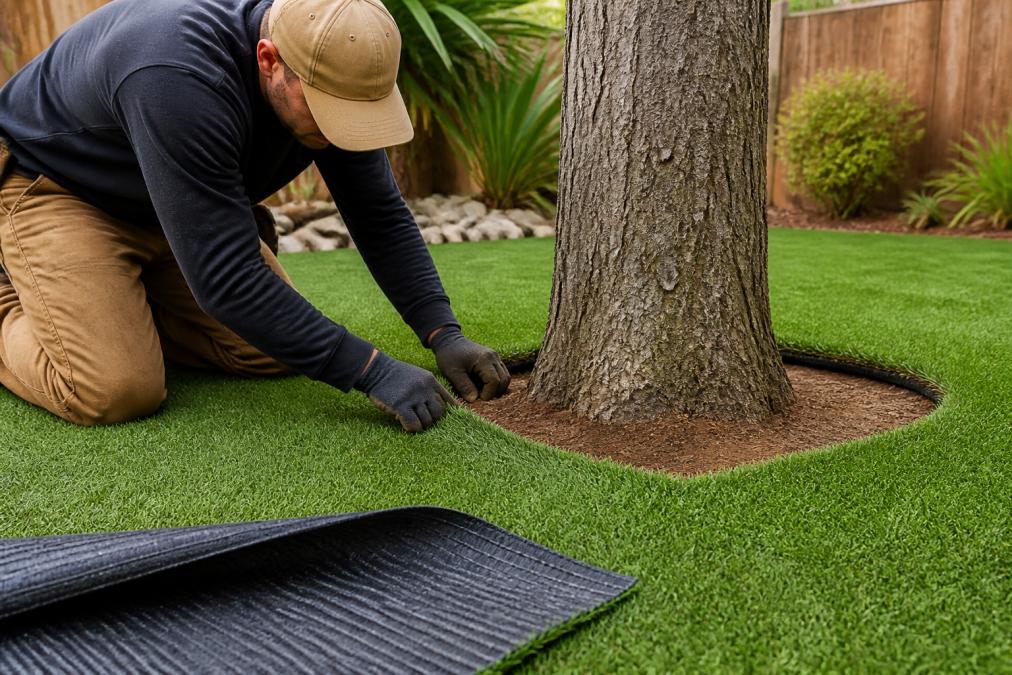
Table of Contents
- Why Tree Health Matters When Installing Artificial Grass
- Understanding Artificial Grass Tree Well Design
- Synthetic Turf Drainage Requirements for Tree Areas
- Essential Artificial Grass Installation Tools
- Step-by-Step Installation Process Around Trees
- Common Mistakes to Avoid
- Tree Species Compatibility and Long-Term Root Health
- Frequently Asked Questions
Last Updated: September 19, 2026
Why Tree Health Matters When Installing Artificial Grass
Learning how to install artificial grass around trees requires a different approach than open ground. Trees need oxygen, water, and space for root growth. Improper installation blocks these needs and causes long-term root damage.
A tree’s root flare, where roots spread from the trunk, needs protection and room to expand. Girdling roots develop when soil compacts or installation materials block growth, slowly strangling the tree.
Proper installation prevents this damage and keeps trees thriving for decades.
Understanding Artificial Grass Tree Well Design
A tree well is the open space you create around a tree trunk before laying artificial grass. It’s not just decorative, it’s essential for tree survival. The well allows the root flare to expand naturally and gives the tree access to water and oxygen that would otherwise be blocked by turf and infill material.
Your tree well should extend at least 2 to 3 feet from the trunk. For larger, mature trees, go bigger. A small well becomes a problem in 5 to 10 years when roots outgrow the space.
Sizing Your Tree Well
Measure your tree’s trunk diameter at chest height. Your well should be at least 1.5 times the trunk diameter, minimum.
For young trees under 4 inches in diameter, a 3-foot well is usually enough. For mature trees over 8 inches, use a 4- to 5-foot well. Undersized wells are a top reason installations fail.
When in doubt, make the well larger than you think you need. Excess space around a tree is never a problem. A well that’s too small will cost you thousands in tree removal or repair later.
Root Flare Protection
The root flare is where the tree transitions from trunk to roots. Many installations bury it by laying turf too close or piling infill against it, causing slow-motion strangulation.
Keep the root flare completely exposed. Don’t cover it with turf, mulch, or infill. The root flare should be visible and clear of any covering material. This means your tree well needs to extend past the widest point of the flare.
Synthetic Turf Drainage Requirements for Tree Areas
Synthetic turf needs quick drainage; trees need water reaching their roots. Design a permeable sub-base that lets water through while supporting the turf.
Permeable Sub-Base and Drainage Layer
Your foundation makes or breaks tree health. Start with a permeable sub-base (crushed stone or recycled asphalt) that lets water flow down instead of pooling.
Lay 4 to 6 inches of permeable base material for stability and drainage. Skip landscape fabric, it traps water and blocks oxygen. Use an open-weave drainage mat or expose crushed stone under the turf.
The goal is water permeability: water should move down through the system, not sideways. This keeps the tree roots hydrated while preventing the soggy conditions that cause root rot.
Water Permeability Standards
Quality synthetic turf drains at 30 inches per hour. Your sub-base must match that rate to prevent pooling.
Match your base material drainage to your turf’s capacity. Crushed stone drains at 20 to 40 inches per hour, working well with quality synthetic turf.
Essential Artificial Grass Installation Tools
You need the right tools for proper installation:
- Measuring tape (25-foot minimum)
- Shovel and spade for edging and base prep
- Wheelbarrow for moving stone and infill
- Landscape edging or tree ring (metal or plastic)
- Level to check that your base is even
- Knee pads for comfort during installation
- Work gloves (heavy-duty)
- Seaming tape and adhesive if joining multiple pieces
- Infill material (silica sand or crumb rubber)
- Broom for spreading infill and brushing the surface
The right tools prevent mistakes. A poor level creates drainage problems months later.
Step-by-Step Installation Process Around Trees
Step 1: Prepare the Area and Install Tree Ring Edging
Clear the tree well area. Remove grass, weeds, and debris to bare soil. Level out high spots.
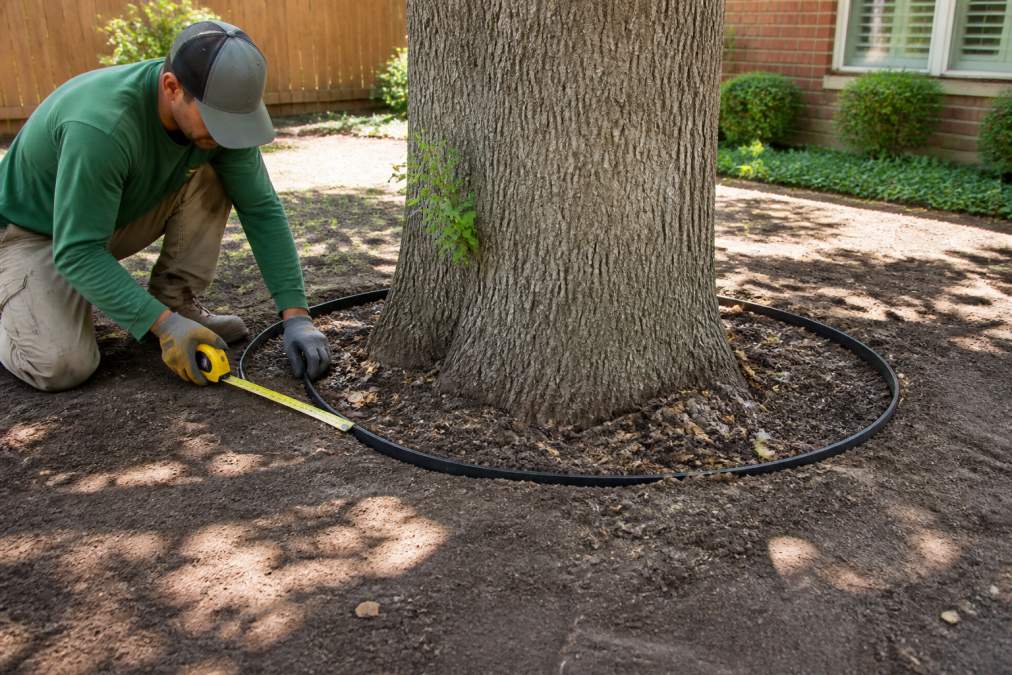
Install tree ring edging around the well perimeter. It prevents turf from creeping into the well and creates a clean visual line.
Drive metal or plastic edging flush with the soil surface, extending 2 to 3 feet from the trunk.
Step 2: Lay the Permeable Base and Drainage Layer
Prep the area outside the well. Remove grass and weeds, then lightly compact the soil.
Step 3: Position and Secure the Turf
Unroll your artificial grass and let it sit in the sun for 15 to 20 minutes. This softens the backing and makes it easier to work with. Position the turf so it runs in the direction you want (most people prefer a natural-looking grain).
Step 4: Add Infill and Final Adjustments
Spread infill material evenly across the turf. Most installers use silica sand or a sand-crumb mix. Spread about 1 to 2 pounds per square foot, depending on the turf’s backing.
Common Mistakes to Avoid
Undersizing the tree well. This is the number one mistake. A small well saves money now but costs you a tree later. Make it bigger than you think you need.
Tree Species Compatibility and Long-Term Root Health
Not all trees respond equally well to artificial grass installation. Species compatibility depends on root architecture, specifically whether the tree’s roots grow laterally (spreading wide and shallow) or vertically (deep and contained). Understanding your tree’s root pattern before installation prevents costly failures 5-10 years down the line.
Root Architecture and Turf Compatibility
Trees with deep, vertical root systems adapt well to artificial grass because their roots grow downward into undisturbed soil below the turf and base layer. These species rarely exert upward pressure on the installation:
-
Oak species (white oak, red oak, pin oak): Deep taproots with lateral feeders below the root flare. Root flare typically stabilizes by age 15-20 years.
-
Maple species (sugar maple, red maple): Moderate depth with some lateral spread. Generally stable once established.
-
Evergreens (spruce, fir, pine): Fibrous root systems that grow down and out symmetrically. Among the safest choices for turf installation.
-
Ash species (white ash, green ash): Deep roots with moderate lateral spread. Perform well if the well is sized generously (4+ feet).
-
Birch species (paper birch, river birch): Notoriously shallow roots that spread wide and close to the surface. Root flare can expand 8-12 inches annually in young trees. High failure rate with artificial grass.
-
Willow species (weeping willow, pussy willow): Aggressive, moisture-seeking roots that grow horizontally. Often damage underground utilities and will push against turf edges.
-
Elm species (American elm, lacebark elm): Shallow, spreading roots that frequently surface. Require oversized wells (5+ feet) and annual monitoring.
-
Dogwood and redbud: Fibrous, shallow root systems. Better suited to mulch rings than artificial turf.
-
Magnolia species: Surface roots that expand significantly with age. Difficult to manage under turf.
Root Flare Expansion and Well Sizing by Species
The root flare, where the trunk transitions to roots, expands throughout the tree’s life. Young trees (under 10 years old) can add 0.5-1 inch of flare diameter annually. Mature trees (20+ years) add 0.25-0.5 inches per year. This expansion is why initial well sizing matters so much.
Long-Term Monitoring and Failure Patterns
Most failures when learning how to install artificial grass around trees occur between years 5 and 10, when root pressure exceeds the well’s capacity. Watch for these warning signs:
- Turf bulging or lifting at the well edge, indicates roots pressing upward against the boundary.
- Bark damage or cankers on the lower trunk, often caused by girdling roots or soil compaction restricting nutrient flow.
- Leaf thinning or yellowing despite adequate water, suggests root stress from limited space or poor drainage.
- Visible roots surfacing inside the well, the tree is outgrowing its allocated space.
Species-Specific Installation Recommendations
Best candidates for artificial grass: Oak, maple, ash, and evergreens. These can sustain 8-12 years of turf coverage with a properly sized well (3-4 feet) and annual monitoring.
Before installation, consult a certified arborist (find one through the International Society of Arboriculture) to identify your tree species and assess its root architecture. A $150-300 consultation can prevent a $2,000+ tree removal or repair later.
If your tree is a species known for shallow roots and you’ve already installed turf, monitor the well edge monthly during the growing season. Be prepared to enlarge the well or remove the turf if root pressure develops. Waiting until the tree is visibly stressed can cause permanent damage.
Frequently Asked Questions
Can you put artificial grass around a tree?
Yes, you can install artificial grass around trees when you follow proper design and drainage protocols. The key is creating a tree well that allows the root flare to remain exposed and provides adequate oxygen exchange to the soil. A well-designed tree well with permeable sub-base and proper drainage ensures the tree receives water and air while the synthetic turf protects the surrounding landscape from soil compaction and mower damage.
How much space should be left around a tree trunk when installing artificial grass?
Leave a minimum of 18 to 24 inches of clearance around the trunk, extending at least to the outer edge of the root flare. This creates a tree well that prevents girdling roots and allows the trunk to expand naturally as the tree grows. The exact spacing depends on the tree species and mature canopy size. A larger well accommodates future root system development and reduces competition between tree roots and the synthetic turf base materials.
Does artificial grass harm tree roots?
Artificial grass itself does not harm tree roots when installed correctly with proper drainage and aeration. The risk comes from poor installation that compacts soil, blocks water permeability, or exposes roots to excessive heat. Using a permeable sub-base, maintaining adequate spacing around the trunk, and avoiding landscape fabric that restricts oxygen exchange protects root health. Professional installation with attention to drainage requirements ensures the tree receives the water and oxygen it needs.
What goes underneath artificial grass around trees?
Install a permeable sub-base layer (typically 4 to 6 inches of crushed stone or recycled asphalt) that provides drainage and prevents soil compaction. Add a drainage layer above the sub-base to direct surface runoff away from the tree trunk. Avoid solid landscape fabric; instead, use a permeable weed barrier that allows water and oxygen exchange. Within the tree well, consider a mulch ring or organic matter to retain moisture and regulate soil temperature while the synthetic turf handles the surrounding area.