
Table of Contents
- 1. Eliminate Routine Irrigation and Cut Outdoor Water Usage
- 2. Artificial Turf Water Conservation Rebates: How to Get Paid to Save
- 3. Artificial Turf Drainage Systems That Support Groundwater Recharge
- 4. Capture Rainwater Harvesting Opportunities on a Synthetic Lawn
- 5. Synthetic Grass Maintenance Tips That Keep Water Usage Near Zero
- 6. Reduce the Heat Island Effect With Cooling Requirements and Smart Design
- 7. Pair Turf With Water-Wise Landscaping and Water-Efficient Design
- Frequently Asked Questions
Last Updated: October 1, 2026
1. Eliminate Routine Irrigation and Cut Outdoor Water Usage
The fastest way to save water with artificial turf in 2026 is to save water by switching off the sprinkler clock for good. A natural lawn depends on routine irrigation to stay green, and outdoor water usage typically climbs in summer when evaporation peaks. Synthetic turf removes that demand entirely because the surface does not transpire or wilt.
Cutting routine irrigation is the single biggest water-saving move available to most households with a lawn. Everything else in this guide builds on it.
2. Artificial Turf Water Conservation Rebates: How to Get Paid to Save
Water agencies across the country run turf replacement rebate programs that pay property owners per square foot of live grass removed. The programs are administered locally, by municipal water departments, regional water districts, and wholesale agencies, so the rate, cap, and rules change the moment you cross a district boundary.
What most rebate pages agree on:
- Payment is per square foot of qualifying grass removed, not per square foot of turf installed. A common structure pays a base rate for the removal and a bonus rate for installing a permeable surface or a drip-irrigated planted bed in its place.
- There is a project cap. Even generous programs typically stop paying after a set square footage or a set dollar ceiling per parcel, so a large yard may only be partially covered.
- Pre-approval is mandatory. You generally must apply, submit photos and a site plan, and receive written approval before the first shovel hits the dirt. Removing grass first and applying after is the single most common reason applications are denied.
- A post-installation inspection releases the funds. Inspectors verify the grass is actually gone, the base is permeable, and any remaining irrigation has been capped or converted to drip.
How the Application Actually Works
A typical sequence looks like this:
- Confirm the program is open and funded, many run on annual cycles and pause when the budget is exhausted.
- Measure the removal area and photograph the existing lawn with a tape measure or reference object visible.
- Submit the application with a site plan showing the turf footprint and the replacement surface.
- Wait for written approval before demolition.
- Remove the grass, cap the sprinkler zone, install the permeable base and turf.
- Schedule the inspection and submit receipts.
Keep every receipt, the contractor’s license number, and dated before/after photos. Inspectors reject projects that cannot prove the grass was alive and irrigated at the time of application.
Where Homeowners Get Rejected
- Grass was already dead or removed before approval.
- The replacement surface is not permeable, or the base was not compacted aggregate.
- The remaining irrigation still waters the turf area.
- The project exceeds the cap and the applicant assumed the whole yard would be covered.
water efficiency rebate and conservation program guidance
Treat the rebate as a reimbursement, not a discount. You pay the installer in full, then the water agency pays you back after inspection, and only if you got approval first.
3. Artificial Turf Drainage Systems That Support Groundwater Recharge
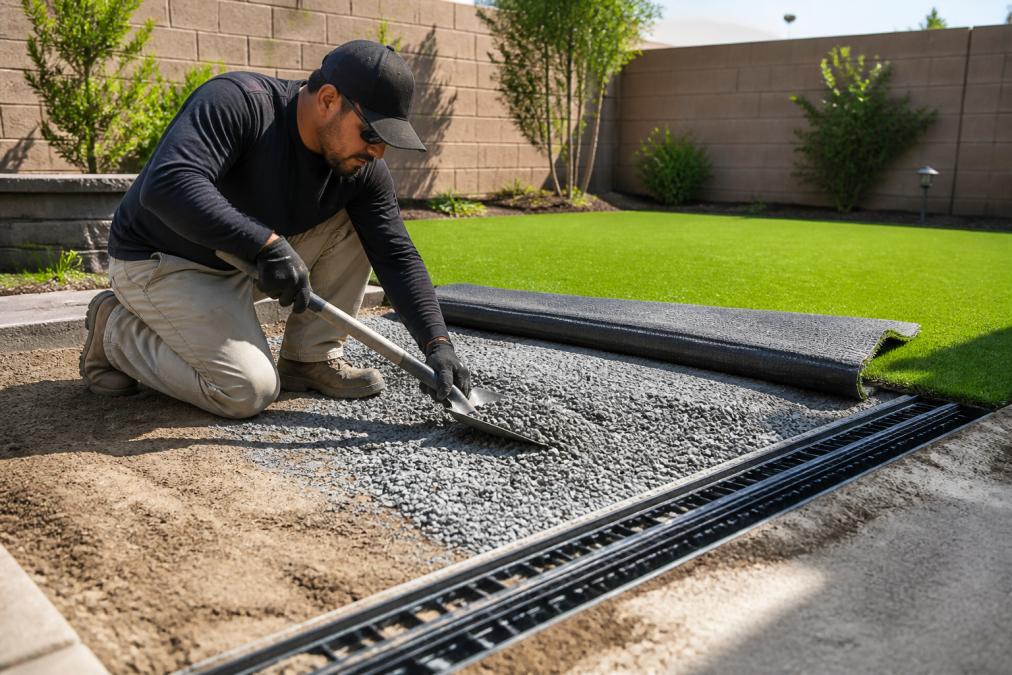
Artificial turf drainage systems determine whether rain soaks into your soil or runs off into the street. A properly built base lets stormwater pass through the surface and filter down, supporting groundwater recharge instead of wasting precipitation.
Permeable Backing and Base Materials
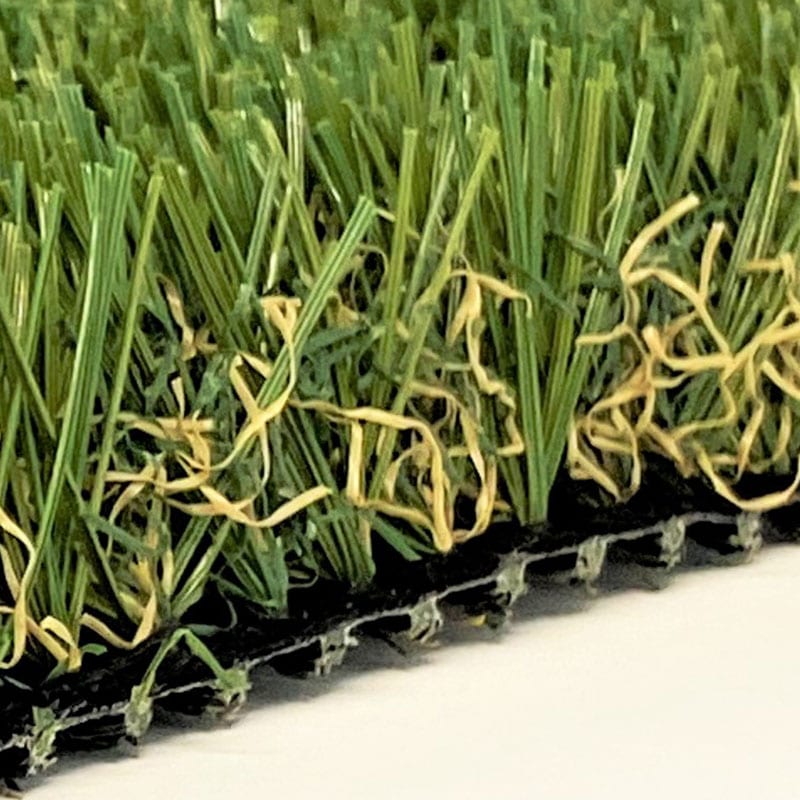
Permeability is the rate at which water passes through a material. Turf with a permeable backing paired with a compacted aggregate base moves water quickly, which matters most during heavy summer storms.
Managing Runoff and Pooling
Poor base prep is the leading cause of standing water on synthetic lawns. If the sub-base is not graded, water collects in low spots and the turf stays soggy for days. Proper slope, drainage stone, and a permeable backing solve this before it starts.
4. Capture Rainwater Harvesting Opportunities on a Synthetic Lawn
Rainwater harvesting pairs naturally with synthetic grass. Because the surface stays clean and free of fertilizer and pesticide residue, runoff from a turf area is often suitable for capturing in a cistern or rain barrel.
5. Synthetic Grass Maintenance Tips That Keep Water Usage Near Zero
Synthetic grass maintenance tips matter because even low-water turf needs occasional rinsing. Pet waste, dust, and pollen build up over time, and a quick hose-down keeps the surface hygienic and odor-free.
Rinse during the coolest part of the day. Water applied at midday evaporates before it does its job, and the surface stays wetter longer if you avoid peak heat.
6. Reduce the Heat Island Effect With Cooling Requirements and Smart Design
The heat island effect is the tendency of hard, dark surfaces to absorb solar radiation and radiate it back, raising local surface temperature above the surrounding air. Standard artificial turf can run substantially hotter than natural grass in direct sun, and the cooling water some owners use to bring that temperature down is a hidden water cost most guides ignore.
Infill Types and How They Affect Surface Temperature
| Infill Type | Cooling Mechanism | Trade-off |
|---|---|---|
| Silica sand | High albedo, reflects more solar radiation | Heavier, can compact; less shock absorption |
| Cryogenic (cryo) rubber | Porous, holds moisture longer after rain or rinse | Darker color absorbs more heat when dry |
| Coated or colored rubber | Lighter pigment reflects more sunlight | Coating can wear over time |
| Organic (cork, walnut, coconut) | Naturally lighter tone, absorbs less heat | Breaks down faster, needs topping up |
| Zeolite or ceramic-coated | Reflects infrared, stays cooler underfoot | Higher upfront cost |
A common pattern is to pair a lighter silica or coated infill with a lighter-colored backing and fiber. The combination reflects more incoming radiation than a dark crumb-rubber system, which means less retained heat and less need to rinse the surface to cool it.
Design Choices That Reduce Retained Heat
- Shade first. Trees, pergolas, and shade sails over the hottest zones cut direct solar gain more than any infill swap.
- Planted borders. Vegetation adjacent to the turf cools the air immediately around it through transpiration.
- Light-colored hardscape. Pale pavers and concrete around the turf reflect rather than re-radiate heat onto the surface.
- Orientation. Turf on the north and east sides of a structure stays cooler than turf on a west-facing exposure that takes afternoon sun.
Water-Saving Potential by Climate Zone
The water savings from switching to turf are not uniform. The table below reflects the general pattern practitioners report; actual savings depend on local evapotranspiration rates, irrigation efficiency, and how much of the yard is converted.
| Climate Pattern | Typical Lawn Irrigation Demand | Relative Water Savings From Turf |
|---|---|---|
| Hot, dry summers with mild winters | High, near year-round | Largest, irrigation demand is highest and turf eliminates it |
| Hot, humid summers | High in peak season | Large, but rinse water for cooling and hygiene offsets some savings |
| Temperate, four-season | Moderate, seasonal | Moderate, savings concentrated in summer months |
| Cool, wet | Low | Smallest, natural grass often survives on rainfall alone |
7. Pair Turf With Water-Wise Landscaping and Water-Efficient Design
Water-wise landscaping treats turf as one element in a larger plan, not the whole yard. The strongest water-saving designs combine synthetic grass for high-use areas with drought-resistant planting, mulch, and drip irrigation elsewhere.
| Approach | Water Demand | Best For |
|---|---|---|
| Full natural lawn | High, year-round | Cool, wet climates |
| Artificial turf only | Near zero | Pet areas, play zones, heavy traffic |
| Turf plus xeriscaping | Low | Mixed yards with planted beds |
| Turf plus rainwater harvesting | Lowest | Gardeners capturing runoff |
Frequently Asked Questions
How much water does artificial turf save compared to natural grass?
A typical natural lawn needs about 1 inch of water per week, which can add up to tens of thousands of gallons per year for an average-sized yard. Replacing that lawn with artificial turf eliminates routine irrigation almost entirely, so you save the vast majority of that outdoor water usage. Exact savings depend on your lawn size, local climate, and how much you currently irrigate. Many homeowners also see lower water utility costs and reduced demand on local water supplies.
Does artificial turf require any water for maintenance?
Artificial turf does not need irrigation to stay green, but a quick rinse with a hose a few times a year helps remove dust, pollen, and pet waste residue. In hot climates, a light spray on especially warm days can cool the surface temperature temporarily. This occasional rinsing uses a tiny fraction of the water a natural lawn needs each week. Following basic synthetic grass maintenance tips keeps water usage near zero while preserving appearance and hygiene.
Can artificial turf help with local water conservation rebates?
Many water utilities and municipalities offer artificial turf water conservation rebates to homeowners who replace natural grass with synthetic turf or other water-wise landscaping. These programs often require specific criteria, such as removing a minimum square footage of lawn, using permeable base materials, or meeting certain product standards. Check with your local water authority for current program details, documentation requirements, and application steps. Rebates can offset part of the upfront installation cost.
How does artificial turf impact drainage and groundwater?
Properly installed artificial turf drainage systems use permeable backing and a compacted aggregate base to let water pass through instead of running off. This design supports groundwater recharge by allowing rainfall to infiltrate the soil below, similar to how a healthy lawn behaves. Drainage capacity varies by product and installation; some systems handle very high flow rates, such as 30 inches per hour. Good base preparation and periodic inspection prevent pooling and keep the system working for years.
Is artificial turf a sustainable choice for residential landscaping?
Artificial turf can be a sustainable option when it replaces a thirsty lawn in a drought-prone area, cutting outdoor water usage and eliminating fertilizers and pesticides. The trade-offs include upfront cost, heat retention in direct sun, and end-of-life disposal. Choosing products with permeable backing, non-abrasive fibers, and responsible manufacturing helps reduce environmental impact. Pairing turf with native, drought-resistant plants in surrounding beds creates a more balanced, water-wise landscaping plan.