
Table of Contents
- Why Pet-Friendly Artificial Grass Requires a Maintenance Routine
- How to Clean Artificial Grass with Dogs: Daily and Weekly Steps
- Removing Solid Pet Waste and Debris
- How Often to Clean Pet Turf for Odor Control
- How to Remove Dog Urine Smell from Artificial Grass
- Safe Artificial Grass Cleaner for Pets: Methods and Products
- Brushing and Restoring Turf Fibers
- Troubleshooting Drainage and Odor Buildup
- Frequently Asked Questions
Last Updated: October 6, 2026
Why Pet-Friendly Artificial Grass Requires a Maintenance Routine
Pet-friendly artificial grass maintenance tips keep turf clean, odor-free, and durable. Many homeowners assume artificial grass is maintenance-free, but pet waste, urine, and debris damage fibers, create odors, and slow drainage.
We’ve helped countless pet owners extend turf lifespan with simple routines that take far less time than natural grass care.
A 10-minute weekly routine prevents expensive repairs; neglect leads to drainage problems, matted fibers, and stubborn odors.
Pet owners should establish a maintenance routine within the first week of installation. Starting early prevents buildup and keeps odors from settling into the base layer.
How to Clean Artificial Grass with Dogs: Daily and Weekly Steps
Split tasks into daily and weekly routines: daily cleanup takes minutes; weekly cleaning prevents odor and keeps fibers upright.
Daily routine (5-10 minutes):
- Remove solid waste immediately with a pooper scooper or plastic bags
- Pick up visible debris like leaves or sticks
- Rinse the spot where waste was with a hose (light spray only)
Weekly routine (15-20 minutes):
- Do a full rinse of high-traffic pet areas
- Brush turf fibers with a soft-bristled brush to restore their appearance
- Check drainage for standing water
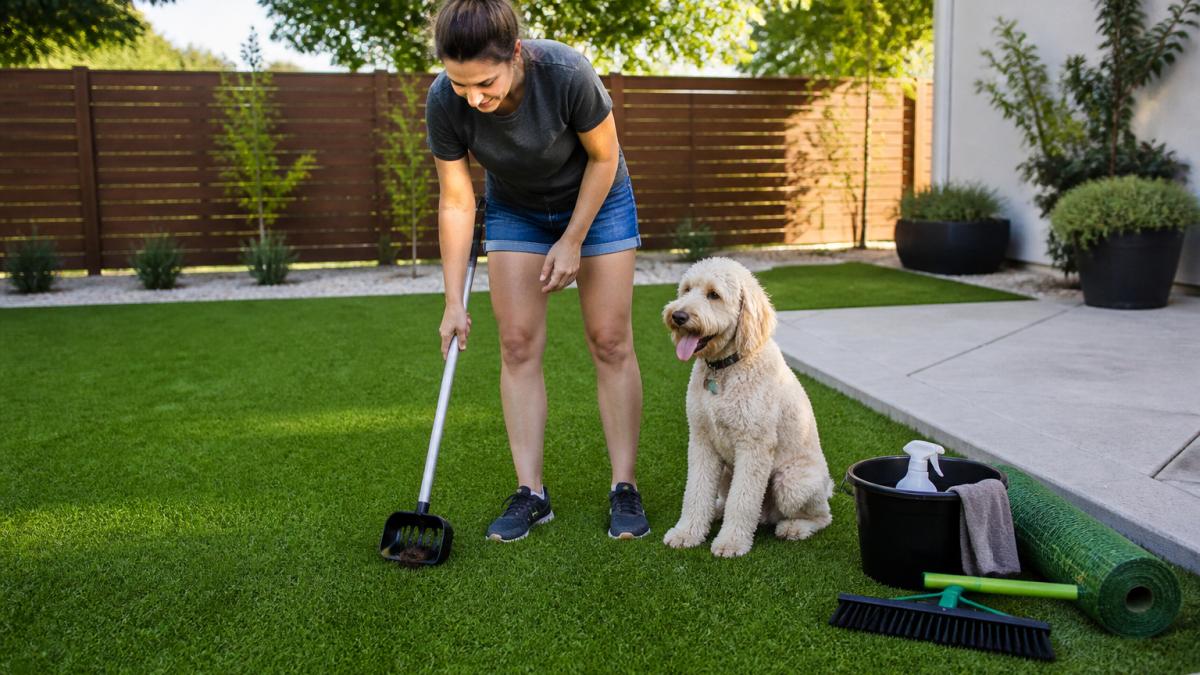
The key to odor prevention is removing waste within 24 hours and rinsing the spot. Solid waste left longer than a day starts breaking down and creates lasting odors.
Removing Solid Pet Waste and Debris
Solid waste removal is the first line of defense against odors and turf damage, the longer feces sits, the more it seeps into the base layer.
How to remove solid waste:
- Use a pooper scooper or small shovel designed for pet waste
- Scoop immediately after your pet uses the area
- Place waste in a plastic bag and dispose in trash
- Rinse the spot lightly with a hose to remove any residue
Clear leaves, sticks, and clippings weekly, debris traps moisture and promotes odor. For multiple dogs or high-traffic areas, pick up morning and evening.
How Often to Clean Pet Turf for Odor Control
Most guides give a single interval, “rinse weekly”, which breaks down with two dogs in a humid summer or one senior dog using the same corner daily. A workable schedule flexes with three variables: pet count, climate, and traffic concentration.
The three variables that actually drive frequency
1. Pet count and urine volume. A small dog produces roughly 0.5 to 1 quart of urine daily; a large breed 2 to 4 quarts.
2. Climate. Heat accelerates bacterial conversion of urea into ammonia; humidity slows evaporation so odor lingers.
3. Traffic concentration. A dog using one 4-by-6-foot corner daily saturates that zone long before the rest of the lawn.
A practical schedule by condition
| Condition | Solid waste | Rinse (full lawn) | Rinse (hot zone) | Deep clean |
|---|---|---|---|---|
| 1 small dog, mild/dry climate | Daily | Every 7-10 days | Every 3-4 days | Monthly |
| 1 large dog or 2 small, mild climate | Daily | Every 5-7 days | Every 2-3 days | Every 3-4 weeks |
| 2+ large dogs, warm/humid climate | Twice daily | Every 3-4 days | Daily | Every 2 weeks |
| Any pet count, rainy season | Daily | Every 7 days (rain supplements) | Every 3-4 days | Monthly |
| Any pet count, freezing conditions | Daily | Skip, water freezes | Spot-pick only | Once after thaw |
A “rinse” is 30-60 seconds of gentle hose spray per zone, pushing urine through the backing, not scrubbing.
How to tell your schedule is wrong
Watch for these signals that you are under-cleaning:
- Ammonia smell within 24 hours of a rinse, the base layer is saturated. Deep clean and shorten your interval.
- Yellow or bleached patches, urine salts concentrate faster than rinsing removes them. Increase hot-zone rinsing.
- Soft, spongy spots, water is not percolating; this is a drainage problem.
Adjusting for seasons
- Summer: Shorten intervals by roughly one-third, bacteria double faster in warm, moist conditions, and surfaces can reach 140-160°F, baking urine salts into fibers.
- Winter: Pick up solids daily and do one thorough rinse on the first warm day above freezing. Do not rinse when overnight temps drop below 32°F, ice in the backing can crack fibers.
- Rainy stretches: Rain dilutes urine but does not replace rinsing; the base still accumulates salts, so keep a weekly rinse.
If you remember one rule: rinse the hot zone on a shorter cycle than the rest of the lawn. Uniform weekly rinsing is the most common reason pet owners still smell ammonia despite “following the schedule.”
How to Remove Dog Urine Smell from Artificial Grass
Dog urine causes the strongest odors because urea breaks down into ammonia. Unlike solid waste, urine soaks into fibers and the base layer, making it harder to remove.
Prevention is the best strategy:
- Rinse urine spots immediately after your dog uses the area
- Use enzyme cleaners weekly if odors persist
- Ensure proper drainage by checking for standing water
For existing odors, enzyme cleaners are most effective, they break down urea and bacteria at the source rather than masking the smell.
For stubborn odors across multiple areas, professional cleaning with commercial-grade equipment can deep-clean the base layer and restore drainage.
Never use bleach or ammonia-based cleaners on artificial grass. They damage polyethylene fibers and can create toxic fumes when mixed. Stick to pet-safe cleaners only.
Safe Artificial Grass Cleaner for Pets: Methods and Products
Choosing the right cleaner protects your pet and preserves your turf. Pet-safe cleaners fall into three categories, enzyme cleaners, vinegar solutions, and mild soap rinses.
Enzyme Cleaners for Persistent Odors
Enzyme cleaners are most effective for urine and feces. They contain bacteria that consume organic matter, the actual odor source, rather than covering the smell.
How to use enzyme cleaners:
- Choose a pet-safe enzyme cleaner (check the label for “safe for pets” or “non-toxic”)
- Dilute according to product instructions
- Spray on affected areas and let sit for 10-15 minutes
- Rinse thoroughly with water
- Allow to dry completely
They work best on fresh odors (within 24-48 hours); older odors may need multiple applications. Many owners apply them weekly during warm months.
Vinegar and Baking Soda Solutions
Vinegar and baking soda are natural, pet-safe, inexpensive alternatives for mild odors, though less powerful than enzyme cleaners.
Vinegar solution method:
- Mix one part white vinegar with three parts water
- Spray on affected area
- Let dry naturally (vinegar smell fades as it dries)
Baking soda method:
- Sprinkle baking soda directly on the area
- Let sit for 30 minutes to 2 hours
- Brush or rake to distribute throughout fibers
Use vinegar and baking soda for prevention and light odors; enzyme cleaners are more reliable for established odors.
Mild Soap and Water Rinse
A simple soap and water rinse removes surface dirt and light odors without harsh chemicals, your go-to for weekly cleaning.
Basic soap rinse:
- Mix warm water with a few drops of mild dish soap (unscented is best)
- Use a soft-bristled brush to scrub the area gently
- Rinse thoroughly with clean water until no soap remains
- Allow to air dry
Mild soap is pet-safe and won’t damage fibers, but it won’t eliminate deep urine odors, it’s for maintenance cleaning, not odor removal.
Brushing and Restoring Turf Fibers
Pet traffic matts down turf fibers, making artificial grass look worn. Brushing restores the upright appearance and improves drainage.
How to brush artificial grass:
- Use a soft-bristled brush (avoid wire or stiff brushes that damage fibers)
- Brush in the direction of the pile (the way the fibers naturally lean)
- Apply gentle pressure, don’t scrub aggressively
- Focus on high-traffic areas where your pet walks most
- Brush weekly or after heavy use
Regular brushing keeps fibers upright, improving drainage and reducing odor buildup while making turf look newer.
For larger areas, a soft rake or broom works, the goal is gentle agitation, not aggressive cleaning.
Brush your turf after rinsing when fibers are slightly damp. Damp fibers respond better to brushing and return to shape more easily than dry fibers.
Troubleshooting Drainage and Odor Buildup
Poor drainage causes most persistent odor problems. If water pools or odors survive regular cleaning, the issue is almost always below the surface, in the infill or base layer. Diagnose each layer in order, from cheapest fix to most involved.
Step 1: Confirm you actually have a drainage problem
Not every slow-drying spot is a drainage failure. Run this test first:
- Pick a 3-by-3-foot section in a low-traffic area.
- Pour a 5-gallon bucket of water evenly across it.
- Time how long until the surface is dry to the touch.
Interpreting results:
- Under 10 minutes: drainage is healthy. Your odor problem is surface-level.
- 10-30 minutes: slow but functional. Infill may be compacted or clogged.
- Over 30 minutes, or standing water: the base layer or drainage path is blocked.
Repeat the test in your pet’s hot zone. A lawn can drain fine in one area and fail in another.
Step 2: Check the infill layer
Infill (silica sand, acrylic-coated sand, or rubber granules) sits between fibers and backing, absorbing urine until water flushes it through. Saturated or compacted infill stops passing water and starts holding odor.
Signs infill needs attention:
- Infill is crusty, hard, or visibly discolored
- Water beads on the surface instead of soaking in
- Odor returns within hours of cleaning
What to do:
- Refresh, don’t just top off. Rake the top inch with a stiff-bristle rake to break up compaction before adding material.
- Top off to the correct level. Infill should sit roughly one-third to one-half up the fiber height, too little flattens fibers, too much buries the drainage path.
- Replace saturated infill. Single-dog households typically replace every 3-5 years; two or more large dogs, every 2-3 years. Rubber holds odor longer than silica.
Step 3: Inspect the base layer
The base layer, typically 3-4 inches of compacted crushed stone topped with finer aggregate, moves water away from the turf. If compacted, clogged, or improperly sloped, no surface rinsing will fix the odor.
How to check it:
- Lift a corner of turf if you have a seam or edge you can access without cutting.
- Look at the aggregate. It should be loose and granular, not caked or muddy.
- Pour a cup of water on the exposed base. It should disappear within seconds.
- Check the slope. Water should move away from the center of the lawn toward the perimeter or a drainage point.
Common base-layer failures and fixes:
| Symptom | Likely cause | Fix |
|---|---|---|
| Water pools in the middle | Base not sloped, or slope reversed | Regrade, usually a professional job |
| Water drains slowly everywhere | Fines migrated into the aggregate | Scarify top layer or add a drainage cell |
| Soft, spongy spots | Saturated sub-base or trapped water | Investigate subsurface drainage; may need a French drain |
| Odor only in one zone | Localized compaction from pet traffic | Aerate the zone, refresh infill, shorten rinse interval |
Step 4: Check the perimeter and drainage path
Even a perfect base layer fails if water has nowhere to go. Check the perimeter for:
- Blocked French or channel drains, clear leaves, mulch, and sediment.
- Downspouts discharging onto turf, redirect them; one downspout can dump hundreds of gallons in a storm.
- Compacted soil at the edges, loosen with a garden fork to restore lateral flow.
Step 5: When to call a professional
DIY covers most surface and infill issues. Call a pro when:
- The base layer needs regrading or replacement
- Standing water persists after clearing drains and refreshing infill
- Odor returns within 24 hours of a full enzyme treatment
A pro can run a percolation test, inspect subsurface drainage, and determine whether the base needs partial or full replacement.
Do not pour chemical drain cleaners, bleach, or ammonia-based products into turf to “clear” a slow-draining zone. They damage polyethylene and polypropylene fibers, can harm your pet’s paws and respiratory system, and do not address the underlying compaction.
The odor-drainage connection
Odor and drainage are the same problem from two angles: urine that cannot drain sits in the infill and base, where bacteria convert urea to ammonia. Fix drainage and most odor complaints resolve. If drainage is healthy and odor persists, replace saturated infill; if infill is fresh and drainage healthy and odor remains, the base layer is the culprit.
Work the layers in order: surface, infill, base, perimeter. Most pet owners find the answer within the first two.
Frequently Asked Questions
How often should you clean artificial grass used by pets?
Daily removal of solid waste is essential to prevent odor and damage. Rinse the turf weekly with water to flush away urine and debris. For homes with multiple pets or heavy use, twice-weekly rinsing prevents odor buildup and extends turf lifespan. Climate and humidity affect frequency, hot, humid conditions may require more frequent maintenance to control odors and prevent drainage slowdown.
What is the best way to remove dog urine smell from artificial grass?
Enzyme cleaners are most effective for breaking down urine compounds. Apply an enzyme-based pet-safe cleaner, let it sit for 15-20 minutes, then rinse thoroughly with water. For persistent odors, a vinegar solution (1 part vinegar to 3 parts water) neutralizes smell naturally. Baking soda sprinkled on damp turf and rinsed after 30 minutes also absorbs odor. Combine methods for stubborn cases and ensure proper drainage to prevent moisture trapping odors.
Is it safe for dogs to pee and poop on artificial grass?
Yes, quality pet-friendly artificial grass is designed to handle pet waste safely. The turf’s non-abrasive polyethylene fibers won’t harm paws, and proper drainage prevents urine pooling. However, consistent maintenance is critical, remove solid waste immediately and rinse regularly to prevent odor, stains, and drainage issues. Check that your turf uses pet-safe infill materials if applicable.
What cleaning products are safe to use on artificial grass with pets?
Mild soap, water, and pet-safe enzyme cleaners are safest for turf with dogs. Avoid harsh chemicals, bleach, and abrasive scrubbers that damage fibers. Vinegar solutions and baking soda are natural, pet-safe alternatives for odor removal. Always rinse thoroughly after cleaning to remove residue. Check product labels for pet-safe certification and test any new cleaner on a small, hidden area first to ensure it won’t discolor or damage the turf.