
Table of Contents
- Why Artificial Grass Drainage Affects Pet Odor
- How Dog Urine Damages Artificial Turf and Creates Odor
- The Role of Turf Backing and Infill in Odor Control
- How to Clean Artificial Grass After Dog Urine
- Artificial Turf Pet Odor Removal Techniques
- How to Prevent Dog Urine Smell on Turf
- Testing Your Drainage System and Diagnosing Odor Problems
- Frequently Asked Questions
Last Updated: October 9, 2026
Why Artificial Grass Drainage Affects Pet Odor
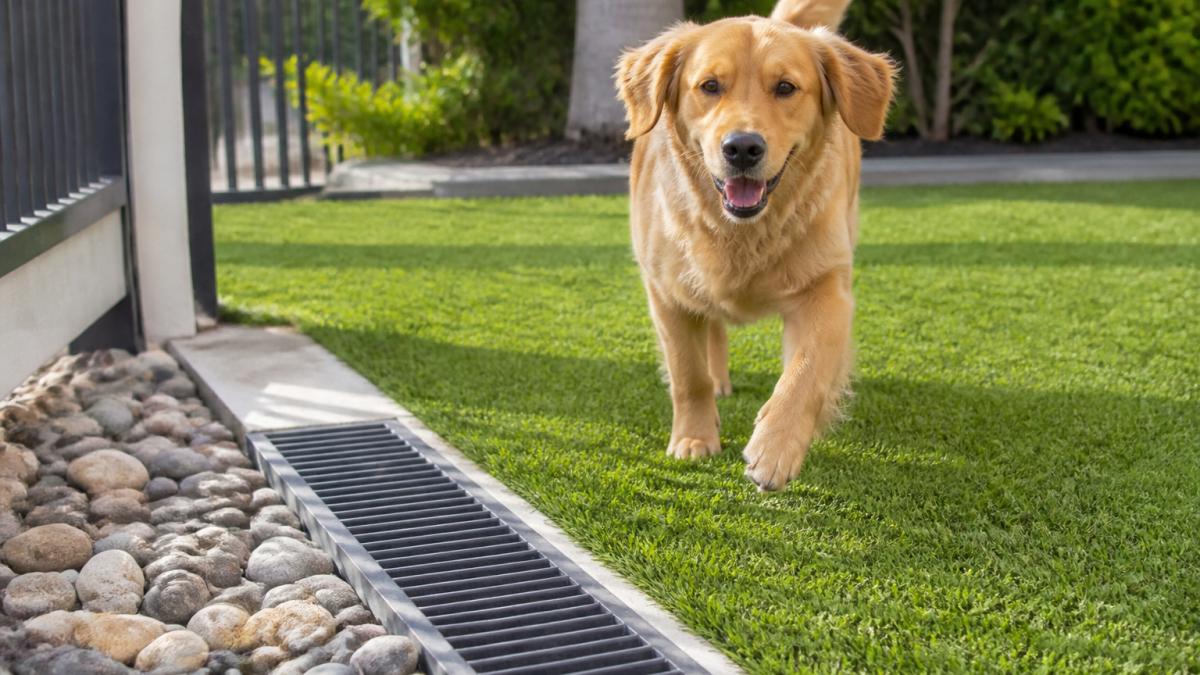
Artificial grass drainage pet odor control starts with proper foundation design. Without it, urine pools on the surface and in the infill, feeding bacteria that produce persistent smells.
When water and urine can’t flow through the turf system quickly, they sit. Bacteria thrive in that moisture, and urine compounds break down into ammonia and other gases.
Does artificial grass drainage affect pet odor? Yes.
How Dog Urine Damages Artificial Turf and Creates Odor
Dog urine doesn’t destroy artificial grass fibers the way it kills natural grass, but it creates chemical and biological problems. Urine’s uric acid, urea, and ammonia accumulate in the turf and infill and don’t break down quickly like they would in soil.
The damage happens in layers:
- Surface buildup: Urine residue sits on top of the turf fibers, attracting bacteria
- Infill saturation: Liquid soaks into the infill material, where it remains longer than in natural soil
- Backing layer: If water reaches the turf backing, it can pool and create anaerobic conditions (no oxygen), which breeds odor-causing bacteria
The smell intensifies because bacteria colonize the infill and backing. Unlike natural soil, artificial turf infill is inert, it doesn’t process urine, it just holds it. The faster urine moves through, the less time bacteria have to multiply.
The Role of Turf Backing and Infill in Odor Control
Two components control whether urine stays trapped or drains away: the turf backing and the infill material.
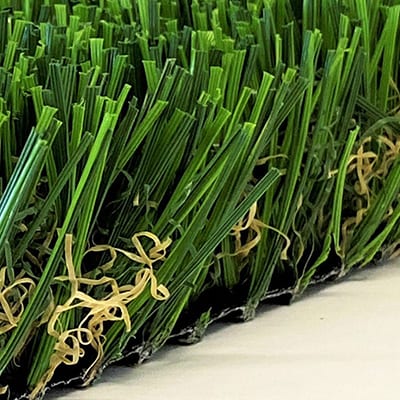
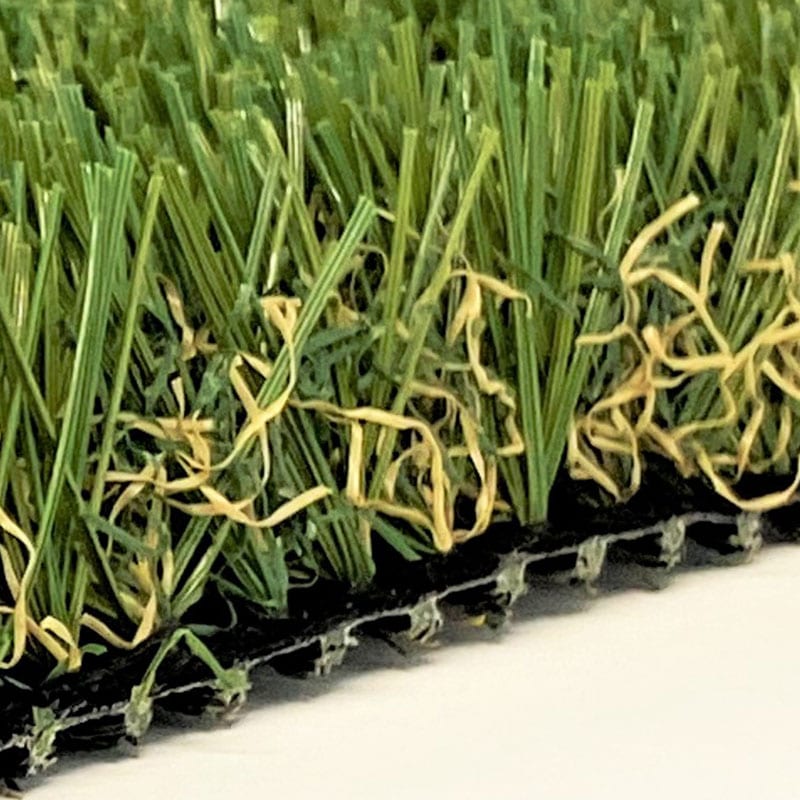
Turf backing is the underside of the artificial grass.
Infill is the granular material (sand, rubber, or specialized blends) between the fibers.
The best infill for pet odor control:
- Drains quickly without compacting
- Doesn’t retain moisture long-term
- Allows airflow to help dry the system
When backing and infill work together, urine moves through fast; when either fails, odor builds up. Installation quality matters, poor work creates low spots where water pools or compresses infill so water can’t flow.
How to Clean Artificial Grass After Dog Urine
Regular cleaning prevents odor buildup by removing urine before bacteria multiply.
Immediate cleanup (within hours):
- Pick up solid waste with a bag or scoop
- Rinse the area with a hose, using moderate water pressure
- Focus on the spot where the urine landed and a 2-3 foot radius around it
- Let the water drain through the turf naturally
For fresh urine spots:
- Use cool or lukewarm water, not hot (heat can set odors)
- Rinse 30-60 seconds to flush urine through the infill
- Repeat if heavily soiled
Weekly maintenance (multiple pets):
- Hose down high-traffic potty areas
- Focus on corners and edges where dogs mark territory
- Rinse the whole pet area weekly in warm months
Consistency is key, regular rinsing stops urine from accumulating into stubborn odors.
Rinse in the early morning or late evening when temperatures are cooler. This reduces water evaporation and gives the turf more time to drain completely before pets use the area again.
Artificial Turf Pet Odor Removal Techniques
If odor has already developed, rinsing alone won’t eliminate it, you need to neutralize bacteria and break down uric acid compounds.
Enzymatic cleaners are most effective. Their bacteria or enzymes break down urine components at a molecular level, eliminating the source rather than masking the smell.
How to use enzymatic cleaners:
- Rinse the affected area thoroughly with water first
- Apply the enzymatic cleaner according to product instructions
- Allow it to sit for the recommended time (usually 15-30 minutes)
- Rinse thoroughly to remove all cleaner residue
- Allow the turf to dry completely before pets use the area
Disinfectant solutions help when bacteria buildup is visible or the smell is severe:
- Mix a mild disinfectant with water per product ratios
- Spray the affected area and let it sit 10-15 minutes
- Rinse thoroughly and ensure complete drainage before pets return
Baking soda method for mild odors:
- Sprinkle baking soda over the problem area
- Let it sit for 24-48 hours
- Rinse thoroughly with a hose
Effectiveness depends on how deep urine has penetrated: surface odors respond quickly, while odors trapped in the infill or backing need aggressive or repeated treatment.
Never use bleach on artificial grass. Bleach can damage the polyethylene fibers and cause discoloration or brittleness. Stick to enzymatic cleaners, mild disinfectants, and water-based solutions.
How to Prevent Dog Urine Smell on Turf
Preventing artificial grass drainage pet odor is really a drainage-design problem in a maintenance costume. If the system underneath can’t move liquid away fast, no rinsing schedule keeps up. It splits into two layers: what’s built in, and what you do weekly.
The design layer: what has to be right before prevention works
Most odor complaints that survive a good cleaning routine trace back to one of five installation variables.
**1.
2. Base material and depth. The base stores and moves water.
3. Compaction. Base must be compacted in lifts, usually 2-inch passes with a plate compactor, not dumped and smoothed at once.
**4.
5. Drain placement and discharge. Water that passes through the turf still has to go somewhere.
The maintenance layer: a schedule tied to pet load, not the calendar
A fixed “rinse weekly” rule ignores how many dogs you have and where they go. Scale frequency to pet load and watch three measurable indicators.
| Pet load | Baseline rinse frequency (warm months) | Baseline rinse frequency (cool/dry months) |
|---|---|---|
| 1 small dog, one potty spot | 2-3x per week | 1x per week |
| 1-2 medium/large dogs | Daily on the potty area | 3-4x per week |
| 3+ dogs or free marking | Daily, full yard 1x per week | Every other day |
These are starting points. Adjust up after rain, in humid stretches, or whenever you notice odor between rinses.
Three indicators to track:
- Drainage time. Pour a gallon on the potty area and time how long it takes to disappear. Slower than a month ago means the infill or base is loading up.
- Rinse-water flow. If water sheets off instead of sinking in, the surface is saturated or the infill is clogged.
- Odor return time. If smell returns within a day of rinsing, you’re wetting the source, not removing it, step up to an enzymatic cleaner and re-check drainage.
Behavioral and site controls that actually move the needle
- Concentrate, then flush. Training dogs to one potty zone concentrates urine, which is easier to manage than urine spread across the yard. Rinse that zone right after use in warm months.
- Airflow. Trim shrubs and remove solid fence panels that block cross-breeze. Airflow dries the infill, and dry infill doesn’t support the anaerobic bacteria behind the worst odor.
- Shade and heat. Full sun dries turf faster but can bake residue into the infill; deep shade stays damp longer. Adjust rinse frequency to your condition.
What to look for in a pet-grade turf system
When comparing products, prioritize:
- Documented backing flow rate, a real number in inches per hour, not a claim.
- Perforated or woven backing, visible holes or a weave you can see light through.
- Infill that resists compaction, angular silica sand, coated sand, or a zeolite-blend infill. Zeolite adsorbs ammonia; standard rubber crumb does not.
- Fiber shape that stands up, curly or texturized fiber holds infill in place and resists matting, keeping drainage channels open.
- A base plan, not just a product, the best turf on a bad base still smells.
Prevention is a system: correct slope, base, backing, infill, drain, and a rinse schedule scaled to your pet load. Get it right and maintenance is routine; get it wrong and you’ll be cleaning forever.
Testing Your Drainage System and Diagnosing Odor Problems
Most odor guides jump straight to “clean it” or “fix your drainage” without helping you figure out which one you have. Odor comes from one of four layers, surface, infill, backing, or sub-base, and each has a different fix. Diagnose the layer first, then treat it; cleaning a drainage problem wastes money, and re-grading a residue problem wastes more.
Step 1: Run the drainage test
Do this on a dry day, at least 24 hours after rain, on the spot where odor is worst.
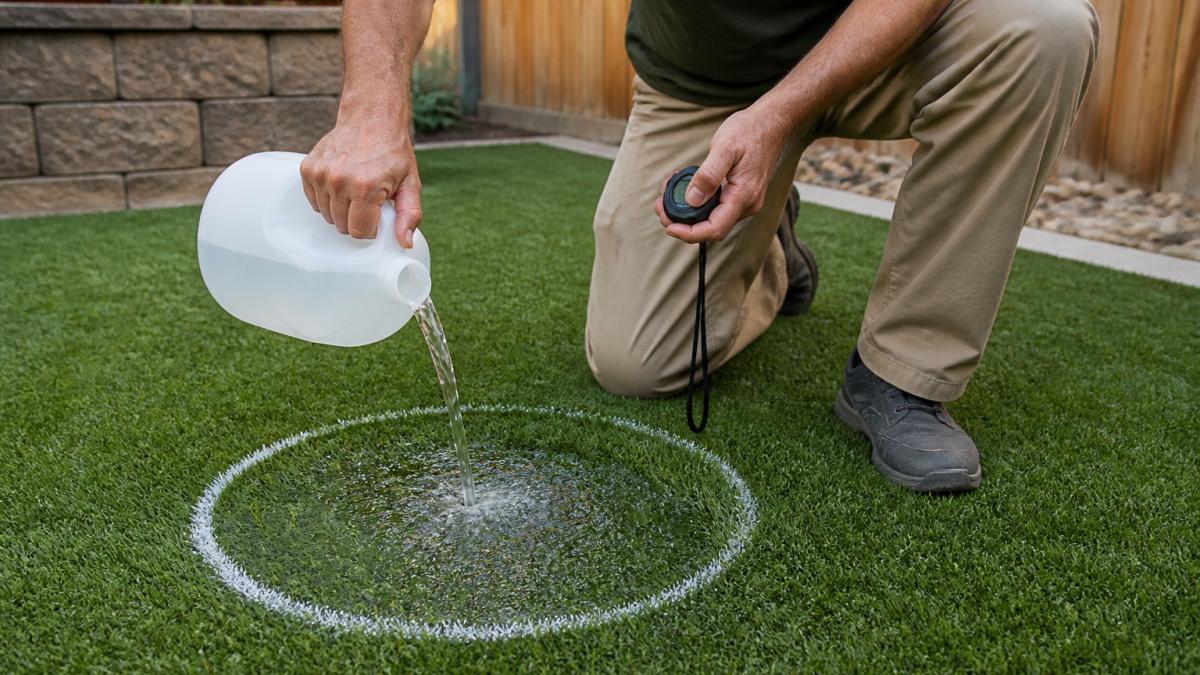
- Mark a 12-inch circle with chalk or a garden hose laid in a ring.
- Pour exactly one gallon of water into the ring, all at once.
- Start a timer the moment you finish pouring.
- Record when the last visible water disappears.
- Repeat on a spot that doesn’t smell, as a control.
How to read the result:
- Under 30 seconds: Drainage is healthy. Your odor is coming from residue, not from a drainage failure. Skip to Step 3.
- 30-60 seconds: Borderline. The system is moving water but not quickly. Odor will build faster than normal. Plan for infill refresh and more frequent rinsing.
- 60-120 seconds: Slow. Infill is likely compacted or clogged, or the base is loading up. Go to Step 2.
Step 2: Isolate the layer
If the drainage test failed, you need to know where the water is stopping. Work top-down.
Test the infill. Compare a handful from the problem area with one from a healthy area.
Test the backing. Pull back a corner or seam and pour a cup of water directly onto the backing.
Test the base. With the turf pulled back, pour a cup of water onto the exposed base.
Step 3: Distinguish drainage failure from urine residue
If the drainage test passed (under 60 seconds) but you still smell odor, the problem is residue, not drainage. Confirm and treat it like this:
| Observation | Likely cause | Fix |
|---|---|---|
| Odor strongest in one spot, drainage test passes | Concentrated urine residue in infill | Enzymatic cleaner, then rinse; repeat 2-3x |
| Odor across the whole yard, drainage test passes | Chronic under-rinsing or high pet load | Increase rinse frequency; add zeolite infill top-dress |
| Odor strongest after rain | Base saturation or blocked outlet | Step 2 base/outlet tests |
| Odor strongest in heat | Ammonia volatilizing from residue | Rinse before peak heat; consider shade |
| Odor returns within 24 hours of cleaning | Source not removed, bacteria in infill or backing | Deep enzymatic treatment; check backing permeability |
| Odor + soft, spongy spots | Water trapped in base | Professional assessment; likely base repair |
Step 4: Seasonal and weather adjustments
The same yard can pass the drainage test in October and fail it in July. Heat, humidity, and rainfall change both odor intensity and drainage behavior.
- Hot, dry stretches: Urine concentrates and ammonia volatilizes faster, so odor spikes even when drainage is fine. Rinse more often, in early morning or evening.
- Humid stretches: Infill dries slowly and bacteria stay active longer. Expect to double rinse frequency.
- Heavy rain: A marginal system saturates and stays saturated. If odor spikes after every storm, your base or outlet is the issue, not your cleaning routine.
Step 5: Safe cleaning for pets, plants, and runoff
Whatever you apply eventually reaches paws, plants, and stormwater:
- Rinse before and after any cleaner. Pre-rinse lifts loose residue; post-rinse removes cleaner pets would otherwise lick off their paws.
- Avoid bleach and high-concentration “quaternary ammonium”, both can degrade polyethylene fibers and leave paw-irritating residue.
- Enzymatic cleaners are the safest default for pet areas; they break down uric acid and urea biologically rather than masking them.
If your drainage test fails and the base or backing is the cause, no cleaner will fix the odor. Cleaning a failed-drainage system just adds moisture to an already saturated base. Diagnose first, then treat.
When to call a professional
Bring in a pro if any of these are true:
- Water pools for more than 60 seconds after a one-gallon test.
- The base test shows water sitting on top of the aggregate.
- Soft, spongy areas don’t firm up after dry weather.
A pro can determine whether the fix is infill replacement, base re-excavation, drain-line clearing, or full turf replacement, and which is actually necessary versus upsold.
The one-gallon test tells you whether you have a drainage problem. The layer-by-layer isolation tells you where. The residue-vs-drainage table tells you what to do about it. Run the test before you buy a single bottle of cleaner.
Frequently Asked Questions
How does poor drainage in artificial grass cause pet odor to get worse?
When artificial grass drainage is inadequate, urine pools in the infill and backing layers instead of flowing through. This creates standing water where bacteria thrive, intensifying odor over time. Proper drainage with a 30 inches per hour capacity ensures urine passes through quickly, preventing organic buildup and the conditions that produce strong smells.
What’s the best way to clean artificial grass after my dog urinates on it?
Rinse the area with a garden hose within a few hours of urination to flush urine through the drainage system before it accumulates in the infill. For established odors, use an enzymatic cleaner designed for artificial turf, which breaks down urine compounds at the source. Apply the cleaner, let it sit for 15-20 minutes, then rinse thoroughly. Repeat weekly during peak use periods.
Can I prevent dog urine smell on artificial turf without constant cleaning?
Yes, prevention starts with installation: choose turf with odor-control infill and a permeable rubber backing that allows water to drain freely. Rinse high-traffic areas weekly with plain water to dilute urine before it concentrates. Designate a specific potty area and rinse it immediately after use. Proper drainage design installed correctly at the start eliminates 80% of odor problems.
How can I tell if my artificial grass drainage problem is causing the odor?
Perform a simple drainage test: pour a bucket of water on the turf and observe how quickly it disappears. Water should drain within seconds to a minute. If it pools or sits on the surface, drainage is compromised. Additionally, if the turf feels swampy or smells worse after rain, poor drainage is the culprit. Check that the sub-base is properly sloped and the infill hasn’t become clogged with debris or pet waste.