
Table of Contents
- What Artificial Turf Infill Is and Why It Matters for Pets
- Types of Infill Materials for Pet Turf
- Pet Odor Infill for Artificial Turf: Zeolite and Beyond
- Zeolite Infill for Pet Turf: Performance and Application
- Artificial Grass Drainage for Pets: Installation and Management
- How to Clean Artificial Turf with Pets: Maintenance and Infill Care
- Calculating Coverage and Installing Infill Correctly
- Pet Safety and Non-Toxic Infill Standards
- Frequently Asked Questions
Last Updated: October 17, 2026
What Artificial Turf Infill Is and Why It Matters for Pets
Infill for pet artificial turf is the material spread across your synthetic grass to anchor fibers, provide cushioning, and manage drainage. For pet owners, the right infill directly affects odor control, durability, and your dog’s safety.
Without infill, synthetic grass flattens, urine pools on the surface, and odors build up quickly. The right material absorbs moisture, neutralizes ammonia, and keeps your lawn fresh under heavy pet use.
How infill supports drainage and durability
Drainage is where most pet turf fails. Standard materials compact over time, trapping urine and creating swampy conditions. Quality infill resists compaction and channels moisture through the turf backing into your subsurface drainage system.
Durability depends on infill density and composition. Heavier, well-graded infill keeps fibers upright and prevents matting; uneven settling causes bare spots and worn paths.
Why pet owners need specialized infill choices
Dogs urinate frequently and intensely, and standard silica sand alone won’t cut it. Specialized infills with antimicrobial coatings or odor-absorbing minerals handle urine breakdown and reduce ammonia smell.
Pet turf also needs infill that won’t compact under paw traffic; round-grain materials resist compression better than angular sand. The best choices combine drainage, odor management, and long-term stability.
Types of Infill Materials for Pet Turf
Silica sand: the baseline option
Silica sand is the most common and affordable infill, widely available with basic drainage and fiber support. However, it offers limited odor control and can compact over time under heavy pet use.
For pets, silica sand works as a foundation layer but rarely as a complete solution.
Round Premium Silica (RPS) resists compaction better than standard sand, draining better and maintaining fiber support longer, but still provides minimal odor control on its own.
Coated sand and antimicrobial infills
Coated sand infills add a protective layer that reduces odor and resists bacterial growth. Acrylic-coated sand combines drainage efficiency with antimicrobial properties, a step up from basic silica.
Durafill is one example, an infill with Microban antimicrobial coating. The coating inhibits odor-causing bacteria on the infill surface. This approach works well for moderate pet use and adds modest cost over standard sand.
Coated infills cost more than plain silica but less than zeolite, a practical middle ground for better odor control without premium pricing.
Crumb rubber and organic alternatives
Crumb rubber, recycled tire material, provides cushioning and drainage but carries concerns about heat retention and chemical leaching.
Organic infills like cork or coconut fiber are biodegradable and naturally antimicrobial, but they compact more easily than mineral infills and decompose faster in wet climates, requiring frequent replacement.
For most pet owners, mineral-based infills with antimicrobial treatment outperform organic options in durability and odor control; organics suit low-traffic ornamental areas better than active pet zones.
Pet Odor Infill for Artificial Turf: Zeolite and Beyond
How zeolite controls odor
Zeolite is a porous mineral that traps ammonia molecules through a process called adsorption. Unlike materials that simply allow drainage, zeolite actively absorbs odor-causing compounds. This makes it one of the most effective infill choices for pet turf.
Its structure contains millions of tiny chambers that capture ammonia gas and liquid as urine drains through, dramatically reducing odor, often within days of application.
Zeolite also improves drainage by creating moisture pathways, resists compaction better than sand alone, and maintains performance over multiple seasons.
Other odor-control infill options
Beyond zeolite, volcanic ash offers a similar porous structure and ammonia-absorbing properties; it’s less common but equally effective for odor reduction.
OptiFILL+ is a specialty blend for pet turf combining drainage efficiency with odor control, costing about $0.30 more per square foot than basic silica sand, a premium often worth the performance gain.
| Infill Type | Primary Benefit | Best For | Odor Control |
|---|---|---|---|
| Silica Sand | Affordability | Budget-conscious installations | Minimal |
| Coated Sand | Antimicrobial coating | Moderate pet use | Moderate |
| Zeolite | Ammonia absorption | High-traffic pet areas | Excellent |
| OptiFILL+ | Specialty blend | Pet-focused projects | Very Good |
| Envirofill | Compaction resistance | Long-term durability | Moderate |
Zeolite Infill for Pet Turf: Performance and Application
Drainage benefits of zeolite
Zeolite’s porous structure drains far better than solid sand particles, moving water through quickly to prevent urine pooling. Rapid drainage is critical, since standing moisture breeds odor and bacteria.
Zeolite also maximizes subsurface drainage compatibility, channeling moisture efficiently into your drainage layer and away from the root zone.
Zeolite also doesn’t hold heat like dark sand or rubber, keeping surface temperatures lower for dogs’ paws during hot months.
Cost and coverage considerations
Zeolite costs more than standard silica sand but less than some specialty blends. Coverage rates typically run 8-15 pounds per square foot, depending on turf pile height and desired infill depth.
Calculating exact quantities matters for budgeting. Pile height determines infill needs: taller pile (2-3 inches) requires more for proper fiber support and drainage, shorter pile (1.5-2 inches) uses less.
Southern Artificial Turf‘s premium turf systems are engineered with drainage capacity of 30 inches per hour, meaning they handle high-volume moisture movement.
Artificial Grass Drainage for Pets: Installation and Management
Infill depth and urine management
Proper infill depth is essential. Most systems require 1.5-2 inches to support fibers and manage moisture; shallow infill causes matting and poor drainage, while excessive infill wastes material and creates compaction issues.
For pets, aim for the higher end of recommended depth; concentrated urine needs sufficient infill volume for moisture distribution and odor absorption, and underfilled turf fails quickly.
Urine management depends on three factors: infill type, infill depth, and subsurface drainage. Zeolite or coated sand absorbs ammonia. Adequate depth provides volume for moisture distribution.
Turf backing compatibility and subsurface drainage
Your turf backing determines how effectively moisture moves away from the surface. Quality backing is highly permeable; cheap backing can become waterlogged, trapping moisture in the infill and creating odor problems.
Southern Artificial Turf‘s systems are engineered with drainage capacity of 30 inches per hour, ensuring water moves through the backing efficiently.
Subsurface drainage, the layer below your turf backing, must also be adequate. Compacted soil, clay, or poor grading can prevent moisture from draining away. If your yard has drainage issues, address them before installation.
Check your yard’s natural drainage before installation. Pour water on the soil and observe how quickly it absorbs. If water pools or drains slowly, invest in subsurface drainage improvements. Poor drainage underground will cause turf problems no matter what infill you choose.
How to Clean Artificial Turf with Pets: Maintenance and Infill Care
Regular rinse and deodorizing schedules
Weekly rinsing removes fresh urine and solid waste before odors develop. Use a garden hose with moderate pressure, high pressure can displace infill. Rinse thoroughly, focusing on high-traffic areas where your dog spends most time.
Monthly deodorizing treatments refresh odor-absorbing infill. For zeolite-based systems, this might mean light brushing to refresh the surface layer and expose fresh mineral to air.
Seasonal deep cleaning (quarterly) helps prevent long-term odor buildup. This involves thorough rinsing, brushing to loosen compacted infill, and optional application of enzymatic cleaners designed for pet turf.
Infill replenishment and compaction prevention
Infill gradually settles and compacts under foot traffic. After 12-18 months of heavy pet use, you may notice areas where infill has shifted or compressed. This is normal and manageable.
Brush your turf regularly (monthly or quarterly, depending on use) to prevent compaction. Use a stiff-bristled brush and work against the grain of the fibers.
Partial infill replacement becomes necessary when 10-15% of your original infill has been displaced or compacted. Rather than replacing everything, add fresh infill to high-traffic zones.
Neglecting infill maintenance accelerates turf wear and odor problems. Compressed infill loses drainage efficiency and odor-absorbing capacity. Regular brushing and timely top-ups are far cheaper than premature turf replacement.
Calculating Coverage and Installing Infill Correctly
Determining pounds per square foot
Calculate infill needs using this formula: square footage × desired depth (in inches) × material density (in pounds per cubic foot) ÷ 12 = total pounds needed.
Most pet turf systems use infill at 8-15 pounds per square foot. Here’s how to determine your exact requirement:
- Measure your turf area in square feet
- Check your turf specifications for recommended pile height (typically 1.5-2.5 inches)
- Select your infill material and note its bulk density (zeolite averages 50-60 lbs per cubic foot; silica sand averages 100 lbs per cubic foot)
- Use the formula above to calculate total pounds
Example: A 1,000-square-foot lawn with 2-inch pile height using zeolite (55 lbs per cubic foot):
1,000 × 2 × 55 ÷ 12 = 9,167 pounds (roughly 4.6 tons)
This calculation helps you budget accurately and order the right quantity upfront.
Step-by-step infill application and brushing
Step 1: Prepare the surface. Ensure turf is clean and dry.
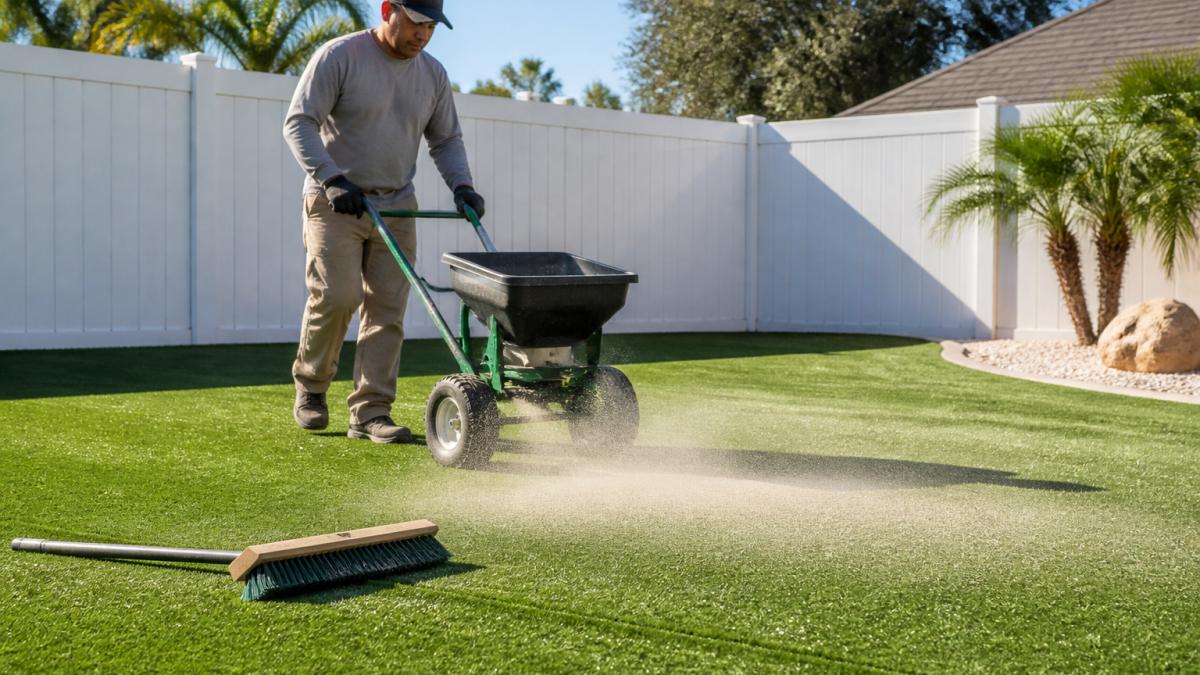
Step 2: Spread infill evenly. Distribute infill across the entire lawn using a drop spreader or by hand.
Step 3: Brush thoroughly. Use a stiff-bristled power brush or hand brush to work infill into the turf fibers.
Step 4: Verify depth. Check infill depth using a ruler or depth gauge at several points.
Step 5: Allow settling. Let infill settle for 24-48 hours before heavy use.
Pet Safety and Non-Toxic Infill Standards
EPA standards and heavy metal testing
The EPA regulates synthetic turf infill through RCRA (Resource Conservation and Recovery Act) hazardous waste standards, particularly for heavy metals like lead, cadmium, and chromium.
Reputable manufacturers provide third-party testing documentation showing heavy metal levels are below EPA limits.
Southern Artificial Turf’s systems meet or exceed EPA standards for RCRA hazardous waste heavy metals, including lead.
When selecting infill, ask for test results from an independent lab. Avoid generic “pet-safe” claims without documentation. Real safety verification comes from published test data showing specific heavy metal concentrations.
Heat reduction and surface temperature for dogs
Surface temperature matters for dogs’ paw health. Dark materials like crumb rubber absorb heat and can reach temperatures uncomfortable for bare paws during summer. Lighter-colored infills like silica sand and zeolite retain less heat.
Zeolite’s light color and porous structure keep surface temperatures lower than dense materials. This is a practical benefit for pet turf in hot climates, your dog can play comfortably even during peak afternoon hours.
The best infill for pet artificial turf combines drainage efficiency, odor control, compaction resistance, and safety certification. Zeolite-based systems excel in all four areas, making them the top choice for serious pet owners despite higher upfront cost.
Choosing the right infill determines whether your artificial turf thrives or becomes a maintenance headache. When paired with proper infill selection, depth calculation, and maintenance schedules, your pet turf will deliver years of clean, durable, mud-free play space. The EPA’s RCRA standards for synthetic materials set the baseline for safety.
Frequently Asked Questions
What is a good pet odor infill for turf?
Zeolite is widely recommended for pet odor control because its porous structure absorbs and traps urine odors. Acrylic-coated sand with antimicrobial properties also performs well. For best results, choose an infill rated for pet use, apply it at the manufacturer’s recommended depth, and rinse the turf regularly. Silica sand alone offers minimal odor control compared to specialty options.
How often should pet turf infill be cleaned or replenished?
Rinse your pet turf weekly with a hose to remove urine and debris. Deep clean monthly using an enzymatic pet odor cleaner. Infill typically requires replenishment every 1-2 years depending on foot traffic and pet activity, as compaction and displacement occur naturally. Check for low spots or thin coverage, which indicate it’s time to add more infill and brush it in evenly.
Is there a pet-friendly artificial grass infill available?
Yes. Pet-friendly options include zeolite, coated antimicrobial sand, and specialty blends designed specifically for pet areas. These infills meet non-toxic standards, control odor, and manage drainage better than standard silica sand. Verify that any infill meets EPA standards for heavy metals and is certified safe for pets before purchase.
How do I calculate how much infill I need for my artificial turf?
Multiply your turf area in square feet by the recommended infill depth in pounds per square foot. Most pet turf requires 1.5-2.5 pounds per square foot, depending on pile height and infill type. Measure your area carefully and consult the turf manufacturer’s specifications. Account for 10-15% extra to compensate for settling and compaction over the first few months.